War and bureaucratization
PSCI 2227: War and State Development
April 15, 2026
Recap
Monday. Brewer on the British fiscal-military state.
- Principal-agent framework — divergent interests, information asymmetry, imperfect monitoring
- Loyalty-competence tradeoff in selecting agents
- England’s shift from tax farming to the Excise
Today. Chen on pre-imperial China.
- Same questions, very different context
- When does warfare push rulers toward bureaucratic administration, and when does it push them away?
Today’s agenda
- Finishing up bureaucracy
- Chen’s theory
- Fief vs. county as alternative principal-agent contracts
- Different incentives for defensive vs. offensive war
- Evidence from pre-imperial China
Bureaucratization
The bureaucratic ideal
Max Weber (remember him!?) laid out the ideal-type bureaucracy:
- Hierarchy: clear chain of command, defined responsibilities
- Rules: written procedures, not personal discretion
- Merit: selection and promotion based on qualifications
- Salaries: officials paid fixed wages, not fees or a cut of revenue
- Separation: office and officeholder are distinct — you don’t own the job
“Bureaucracy” in this sense isn’t just red tape
Administration as more systematic, less idiosyncratic
Bureaucracy as an answer to agency problems
How does bureaucracy help reduce agency problems?
- Rules + hierarchy \(\leadsto\) easier monitoring
- Merit + salaries \(\leadsto\) attracts competent agents
- Separation \(\leadsto\) officials are replaceable, reducing their bargaining power
Bureaucracy makes the loyalty-competence tradeoff less severe
- Institutional controls substitute for personal loyalty
- You don’t need to trust the agent as much when the system constrains what they can do
Bureaucracy as a cause of agency problems
While solving some agency problems, bureaucracy can create others
- Rigidity: rules designed for typical cases fail on edge cases
- Tunnel vision: distorting actions to hit measurable/numerical targets
- Slow adaptation: hierarchy means less adaptation, especially in crisis
- Rent-seeking: bureaucracy starts trying to aggrandize its own power
- Capture: placing outside interests above the principal’s
Dealing with bureaucracy
Discussion question
What aspects of Vanderbilt are more or less “bureaucratic” in Weber’s sense — hierarchical, rule-bound, oriented more around process than people?
And what are the upsides and downsides of the more bureaucratic parts of the Vanderbilt experience, compared to the less bureaucratic ones?
War and bureaucratization
Questions we’ll ask
Why did some states develop bureaucratic administration before others?
To what extent, or in which cases, was warfare an impetus to bureaucratize?
Once a state has bureaucratized, how does that affect its approach to war?
Context — pre-imperial China
771 BCE: Zhou collapse
770–481 BCE: Spring and Autumn period, gradual fragmentation
481–221 BCE: Warring States period, intense competition
221 BCE: Qin unification
Chen’s focus: Jin and Chu states
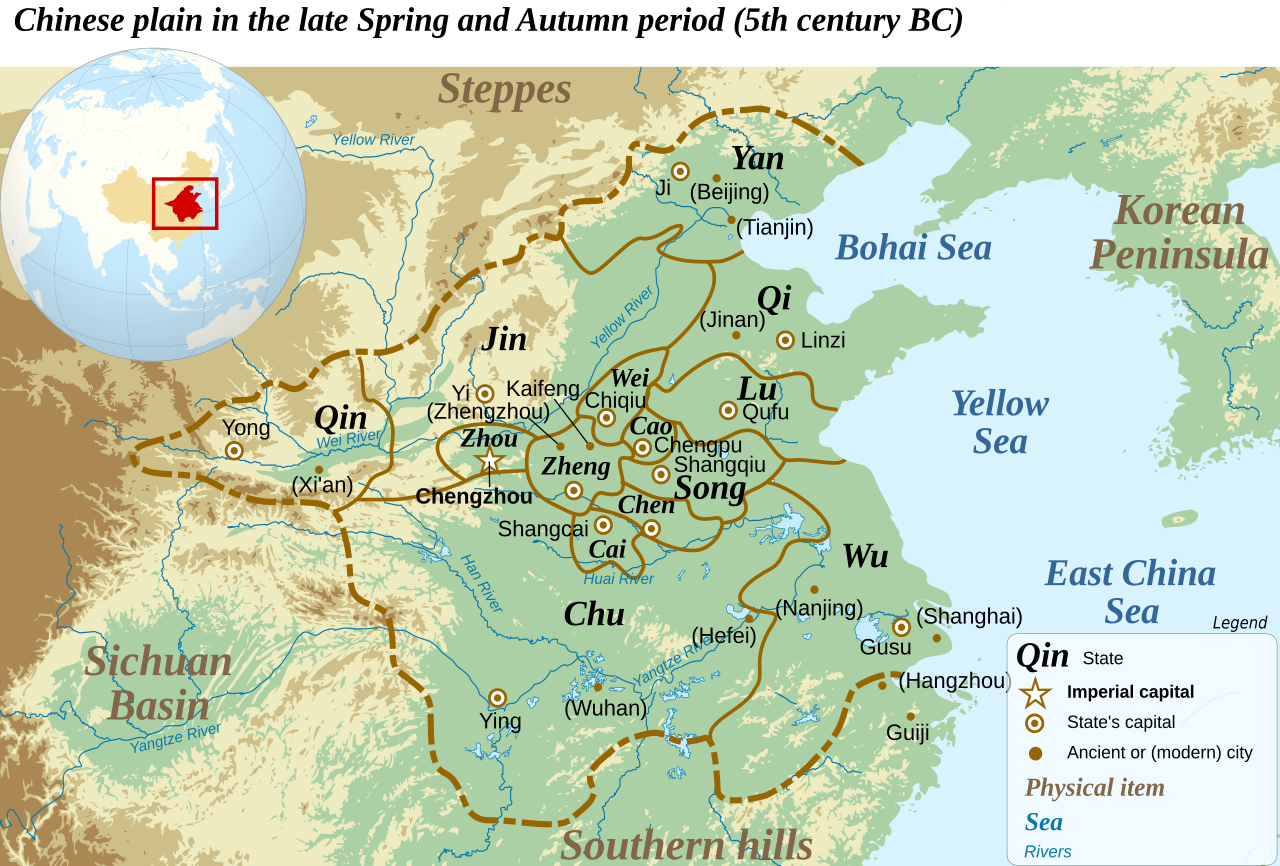
Two ways to run a district
Fief
- Granted to a hereditary noble
- Noble owns the domain — keeps all tax revenue
- Raises a private army from his own dependents
- Ruler cannot remove him at will
County (xian)
- Run by an appointed magistrate
- Magistrate draws a wage — revenue flows to the ruler
- Commands troops supplied by the ruler
- Ruler can fire and replace him at will
The fief is personal property; the county is a bureaucratic post
Local incentives in defensive war
Foreign army invades the district. Does the local agent fight hard?
Fief holder
- Success \(\leadsto\) keeps the domain
- Failure \(\leadsto\) loses everything, possibly his life
- Skin in the game — clear reason to fight hard
County magistrate
- Success \(\leadsto\) keeps a small wage
- Failure \(\leadsto\) just loses the wage
- Stakes are low either way — minimal intrinsic incentive
Fiefs are better defenders because of greater intrinsic incentive
Local incentives in offensive war
Ruler orders an attack on an external enemy. Does the local agent go along?
Fief holder
- Already keeps his domain income — why risk it?
- Spoils would be his, but so would the casualties
- Little incentive to fight, ruler can’t make him
County magistrate
- Gets only a small cut of the spoils if the attack succeeds
- But if he refuses, the ruler fires him and installs someone who won’t
- Personnel control substitutes for intrinsic motivation
Counties are more aggressive because the ruler can force participation
Ruler’s incentives to bureaucratize
The ruler picks the contract before knowing which contingencies will arise
Core tradeoff:
- High expected defensive threat \(\leadsto\) fief
- Agent’s own property interest substitutes for monitoring
- High expected offensive opportunity \(\leadsto\) county
- Personnel control lets the ruler compel participation
Two predictions fall out:
- Fiefs cluster where external threat is high
- Counties fight more aggressively, especially far from home
Decision to bureaucratize: research design
Unit of analysis. Administrative district in Jin or Chu, 772–221 BCE
Dependent variable. Is the district a fief or a county?
Independent variable. Is the district on the state’s border?
- Proxy for anticipated external threat
Predicted relationships.
- Disproportionately fiefs in border districts
- Disproportionately counties in non-border districts
- Strongest differences when neighbor is stable and strong
Decision to bureaucratize: results
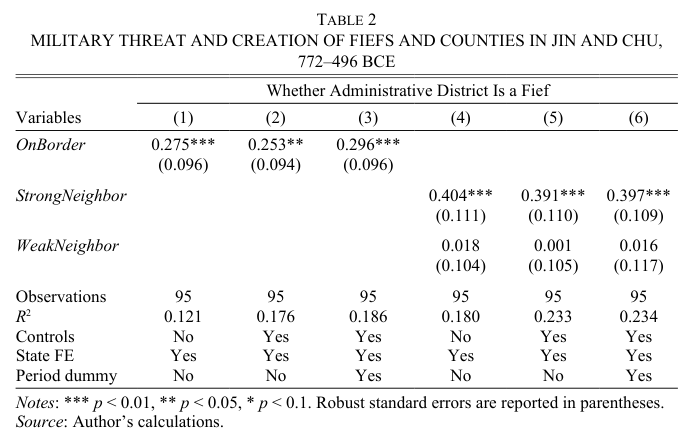
Border districts 25–30 percentage points more likely to be organized as fiefs
Table 3: bigger differences when neighbor is stable or strong
Effects of bureaucratization on war: research design
Unit. Same districts, observed by decade
Dependent variable. District-level aggressiveness
- Number of attacks at 0–50 miles (nearby) vs. 51–150 miles (distant)
- Average distance from the district to its attack sites
Independent variable. Is the district a fief or a county?
Predicted relationships.
- Fiefs and counties about equally likely to launch close attacks
- Counties more likely than fiefs to launch distant attacks
- Average distance to attack is higher for counties
Effects of bureaucratization on war: results
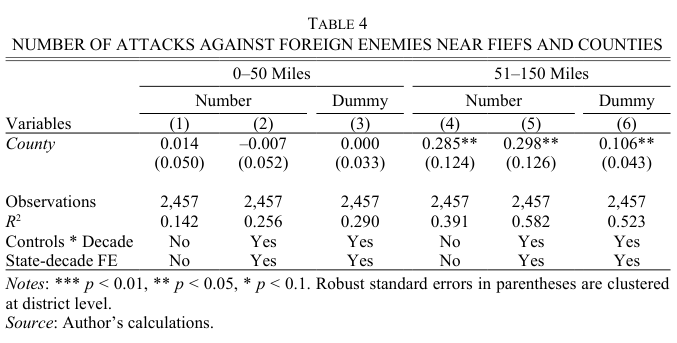
No statistical difference in nearby attack propensity
Counties launch about 0.3 more faraway attacks per decade
Appendix results: avg distance 16–20 miles higher for counties
Wrapping up
What we did today
Bureaucratization, its upsides and downsides
Chen’s fief vs. county framework
- Fiefs give the agent skin in the game — best for defense
- Counties give the ruler personnel control — best for offense
Evidence from Jin and Chu
- Fiefs cluster on threatened borders
- Counties fight the ruler’s distant wars
What’s left from here
Friday, 11:59pm. Final research paper + revision memo due.
- Please submit PDFs
- Try to email questions to me by tomorrow, I’m at a conference on Friday
Evaluation extra credit. 12 filled out as of last night — we need 8 more for +0.5, 13 more for +0.75.
Monday 4/20. Final exam review — I’ll post a study guide no later than that class, hopefully even earlier.
Thursday 4/23, 9:00–11:00am. Final exam.