Bureaucracy

PSCI 2227: War and State Development

Prof. Brenton Kenkel

Vanderbilt University

April 13, 2026

Extra credit opportunity: Course evaluations

Course evaluations: https://my-vanderbilt.bluera.com/

My goal: No less than 20 completed, ideally 25+

Extra credit scheme: Everyone gets extra points depending on response rate

Responses Final grade bump
0–19 none
20 +0.50
21 +0.55
22 +0.60
23 +0.65
24 +0.70
25+ +0.75

Inspired by a similar scheme developed by Prof. Emily Ritter.

Also see Myatt and Wallace, The Economic Journal 2009, “Evolution, Teamwork, and Collective Action.”

Extra credit opportunity: Your privacy

Before grading: All I see is how many have been filled out

After final grades are submitted: I see the anonymized content of the evaluations

What I never see:

  • Names of who submitted or didn’t
  • Any personal identifying info on individual evaluations
  • Which scores go with which written comments

Recap

Last time (Apr 1). Darden and Mylonas on linguistic commonality.

  • External threats \(\leadsto\) incentive to invest in mass national schooling
  • Indonesia (high threat) vs. Sub-Saharan Africa (low threat)
  • Wrapped up the nationalism unit

Today. Brewer, The Sinews of Power, chapters 3–4.

  • Shifting gears from nationalism to bureaucracy
  • How did the English state transform itself into an effective tax-collecting machine?

Today’s agenda

  1. Agency problems — the conceptual framework
    • What can go wrong when you delegate tasks?
    • The loyalty-competence tradeoff
    • Bureaucracy as a solution
  2. War and Britain’s tax bureaucracy
    • The transformation of English government, 1600s–1700s
    • The Excise as a bureaucratic model
    • How bureaucratic taxation enabled debt finance

Agency problems

The principal-agent relationship

When one person (the principal) delegates a task to another (the agent)

e.g., the king sets the tax rate, but other people go out and collect the money

Why delegate instead of doing it yourself?

  • Lack of time — you have more important things to do
  • Lack of expertise — the task takes specialized skills
  • Lack of knowledge — can’t complete the objective without collecting extra info that you don’t have the time or skills to get

Dangers of delegation

Agents don’t always behave as the principal wishes

  1. Divergent interests
    • Agent’s goals might differ from principal’s
    • Tax collector cares about their own pay, not state revenue
  1. Information asymmetry
    • Hard to evaluate if agent’s action advanced principal’s interests
    • Which tax evaders deserve a break, and which should be punished?
  1. Imperfect monitoring
    • Hard to tell what the agent actually did
    • If tax collections came up short, was the economy bad? Or are the agents stealing the money?

Strategies for controlling agents

  • Monitoring
    • Set objective performance goals
    • Hire other agents to subjectively evaluate work quality
    • Fire agents who don’t meet expectations
  • Incentive alignment
    • Directly tie agents’ compensation to satisfaction of principal’s goals
    • Requires monitoring, can create perverse incentives too
  • Prior selection
    • Get agents in the first place who need minimal monitoring/incentives

Agent selection

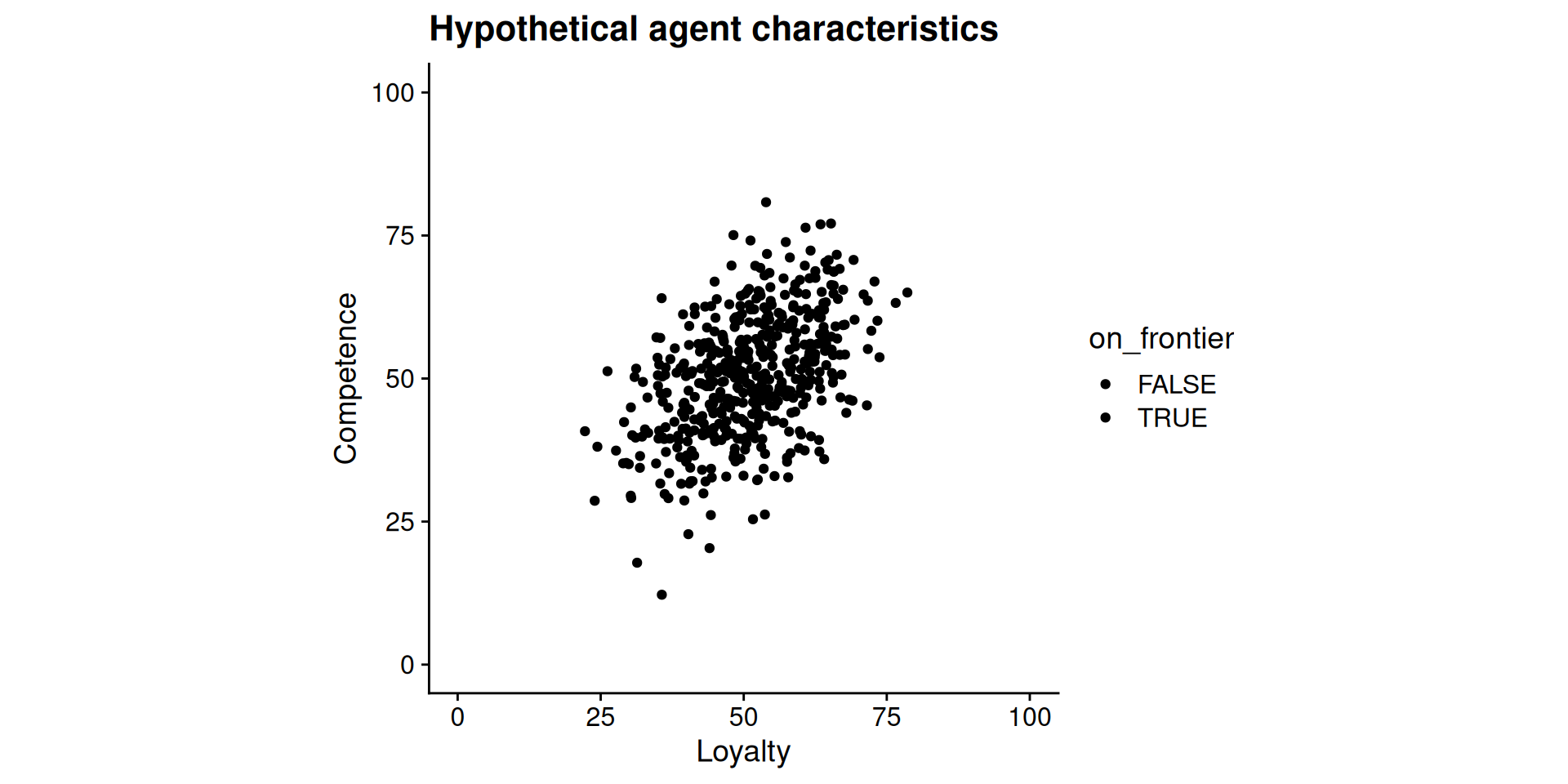
Two qualities a principal wants from an agent:

  • Loyalty: the agent wants the principal to be happy
  • Competence: the agent can do a good job at their tasks

But the most loyal agent is typically not the most competent

Discussion question

What’s a time in your own life where you’ve needed to select an “agent” but faced a loyalty-competence tradeoff? What factors led you to seek loyalty over competence, or vice versa?

The loyalty-competence tradeoff

Problem arises even if more loyal agents are generally more competent
The loyalty-competence tradeoff

Problem arises even if more loyal agents are generally more competent
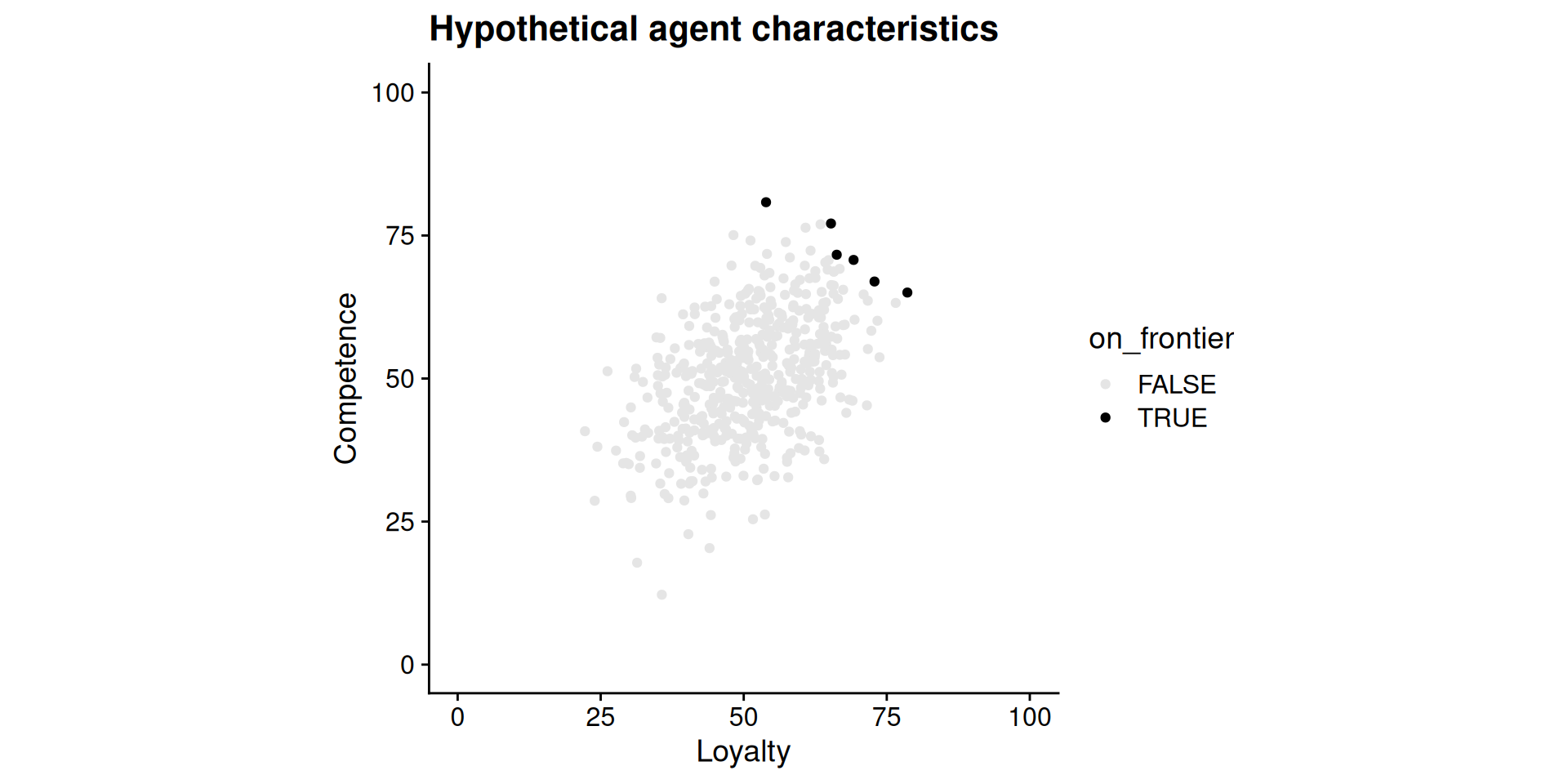
The loyalty-competence tradeoff

Problem arises even if more loyal agents are generally more competent
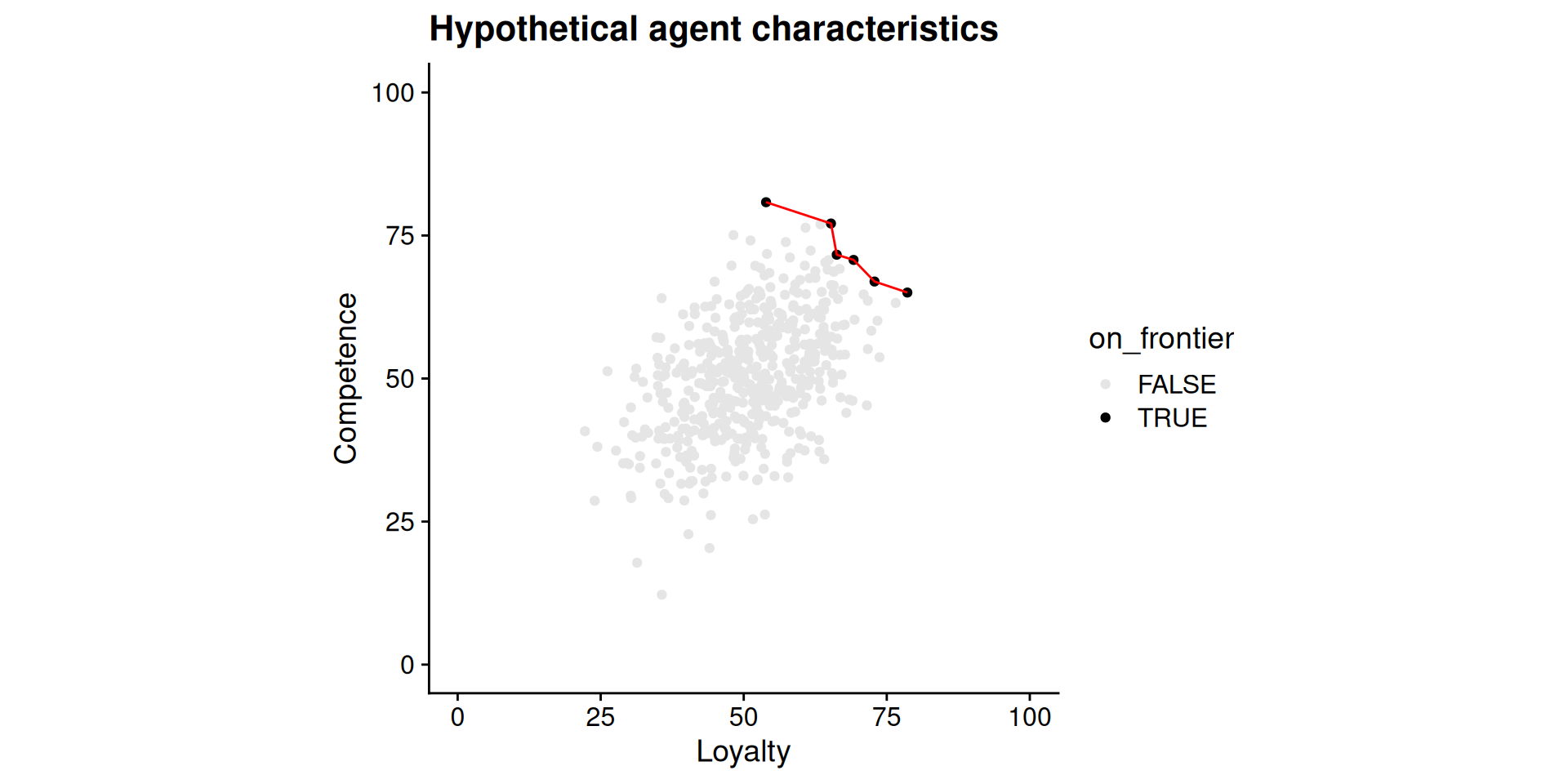
The loyalty-competence tradeoff today

Gen. James Mattis, SecDef 2017–2019
  • Confirmed 98–1
  • Pushed back on NATO, Syria
  • Resigned over policy differences

Pete Hegseth, SecDef 2025–present
  • Confirmed 51–50
  • Career in activism/TV
  • No public disagreement w/Trump

Same principal, different points on the loyalty-competence frontier

Politics and the loyalty-competence tradeoff

What political and institutional factors shape a ruler’s relative preference for more loyalty as opposed to more competence?

Some possibilities:

  • Executive’s fear of insider threat (coup)
  • Executive’s fear of outsider threat (war, revolution, not being reelected)
  • Executive’s time horizon
  • Legislative or legal constraints

Bureaucracy

The bureaucratic ideal

Max Weber (remember him!?) laid out the ideal-type bureaucracy:

  • Hierarchy: clear chain of command, defined responsibilities
  • Rules: written procedures, not personal discretion
  • Merit: selection and promotion based on qualifications
  • Salaries: officials paid fixed wages, not fees or a cut of revenue
  • Separation: office and officeholder are distinct — you don’t own the job

“Bureaucracy” in this sense isn’t just red tape

Administration as more systematic, less idiosyncratic

Bureaucracy as an answer to agency problems

Why is bureaucracy an answer to the agency problems we’ve been discussing?

  • Rules + hierarchy \(\leadsto\) easier monitoring
  • Merit + salaries \(\leadsto\) attracts competent agents
  • Separation \(\leadsto\) officials are replaceable, reducing their bargaining power

Bureaucracy makes the loyalty-competence tradeoff less severe

  • Institutional controls substitute for personal loyalty
  • You don’t need to trust the agent as much when the system constrains what they can do

England before the fiscal-military state

England in the mid-1600s: a remarkably small government

  • Only about 1,200 identifiable permanent officials
  • Administration run largely by “Enterprisers” — private contractors who raised troops, commanded ships, and collected taxes for a fee or a cut

Key features of this system:

  • Tax collection often farmed out to private individuals who paid the crown a lump sum, then kept whatever they collected beyond that
  • Officials paid by fees, not salaries — income depended on how many transactions they processed
  • Little distinction between the office and the officeholder
  • Minimal oversight, no career structure, no examinations

From tax farming to direct collection

The agency costs of tax farming:

  • Farmer’s incentive: extract as much as possible from the population
  • Crown’s problem: can’t verify whether right amount is collected
  • Public’s problem: loss of trust in crown after dealing with sketchy farmers

Was supplanted by Weberian administration starting in late 1600s

  • Salaried officials — replaced fee-based compensation
  • Career ladders — graded appointments with progressively higher pay
  • Pensions — gave officials a long-run stake in the system
  • Examinations and training — entry requirements for new recruits
  • Internal monitoring — supervisors, auditors, inspectors

War and the transformation of government

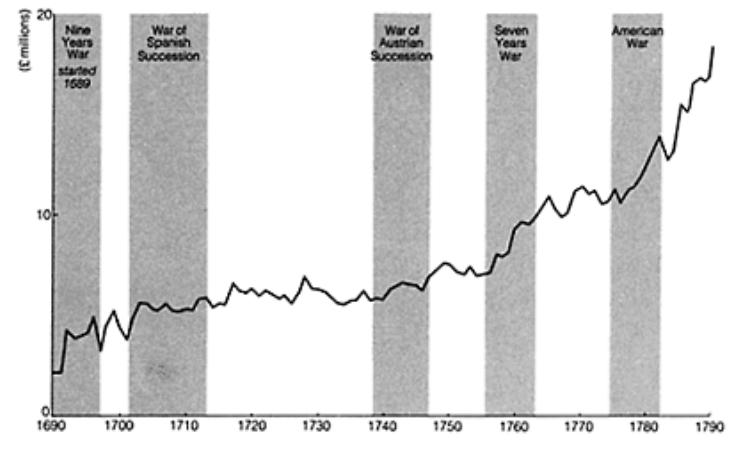
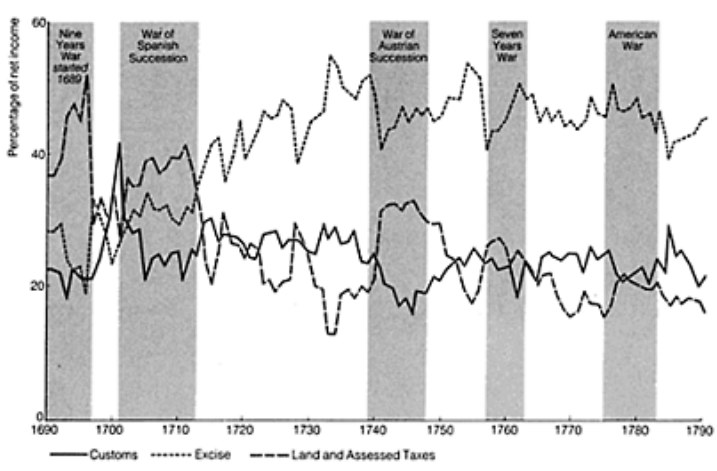
Many wars with France in the 1600s–1700s

  • Nine Years War, 1689–1697
  • War of Spanish Succession, 1701–1714
  • War of Austrian Succession, 1740–1748
  • Seven Years War, 1756–1763

Financing these required much more revenue than old system could deliver
From political loyalty to professional competence

Early on (1690s–1710s): rulers still prioritized loyalty

  • Political purges after changes of government
  • Between June 1694 and June 1695: 121 excise officers (about 10% of the total) discharged for political reasons

Gradual shift toward retaining competent officials regardless of party

  • Cost of firing experienced administrators during wartime became too high
  • “Massacre of the Pelhamite Innocents” (1763): even a major politicized purge kept away from lower levels and avoided firing competent administrators

The Excise

The Excise: an indirect commodity tax on domestically produced goods — beer, spirits, soap, candles, leather, paper, and more

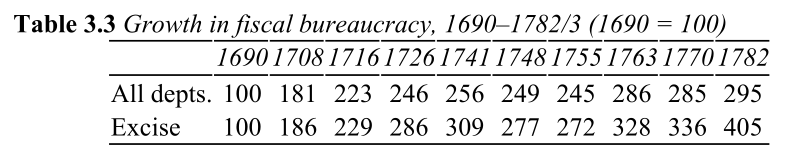
Brewer identifies the Excise Office as the closest approximation to Weber’s bureaucratic ideal in 18th-century Europe

  • Highly centralized hierarchy: Board of Commissioners in London \(\rightarrow\) supervisors in the field \(\rightarrow\) officers on daily rounds
  • Officers passed written and practical exams (decimals, geometry, bookkeeping, the “art of gauging”)
  • Daily “footwalks” (12–16 miles) and “outrides” (40–50 miles) to inspect producers
  • “Removes” system: officers periodically rotated between districts to prevent collusion with local traders

Growth in revenue

Huge increase in excise receipts
Taxes and debt as complements

Thies, Queralt: debt and taxes as alternative ways to pay for war

Brewer: reliable tax collection and debt finance are complements

  1. Parliament earmarked specific taxes to service specific debts (“funding”)
  2. Reliable, bureaucratic tax collection \(\leadsto\) creditors confident they’d be repaid
  3. Creditor confidence \(\leadsto\) government could borrow at lower interest rates

Wrapping up

Coming up

Tomorrow. My office hours, 2:00–3:30pm, Commons 326.

Wednesday. Read Chen 2023, “State Formation and Bureaucratization.”

  • Different context (pre-imperial China), similar questions
  • How does warfare drive bureaucratic development?

Reminder: Final research paper + revision memo due Friday, 11:59pm