War threats and language
PSCI 2227: War and State Development
April 1, 2026
Recap
Last time. Nation-building through war (Sambanis, Skaperdas, Wohlforth).
- Sub-national identities undermine state capacity
- Victory in war \(\rightarrow\) higher national status \(\rightarrow\) more national identification
- Rulers may start wars because of the nation-building payoff
Today. Darden and Mylonas, “Threats to Territorial Integrity, National Mass Schooling, and Linguistic Commonality.”
- War isn’t the only way to build a nation — mass schooling is another
- External threats drive the decision to invest in nation-building
Today’s agenda
- The puzzle: why so much variation in linguistic commonality?
- Theory: external threats and incentives to nation-build
- Evidence: regional patterns and case studies
Theory
Linguistic commonality and nationalism
Impossible to measure “nationalism” directly
Shared language is a reasonable (though imperfect) proxy for social scientists
Basic logic of focusing on language:
- Imagined community — people who’ve never met feel a shared fate
- A common language is close to a prerequisite for this
- Shared media, shared literature, shared political discourse
- Hard to imagine community without communication
- Anderson: spread of nationalism largely coincident w/ print media
Regional variation in linguistic commonality
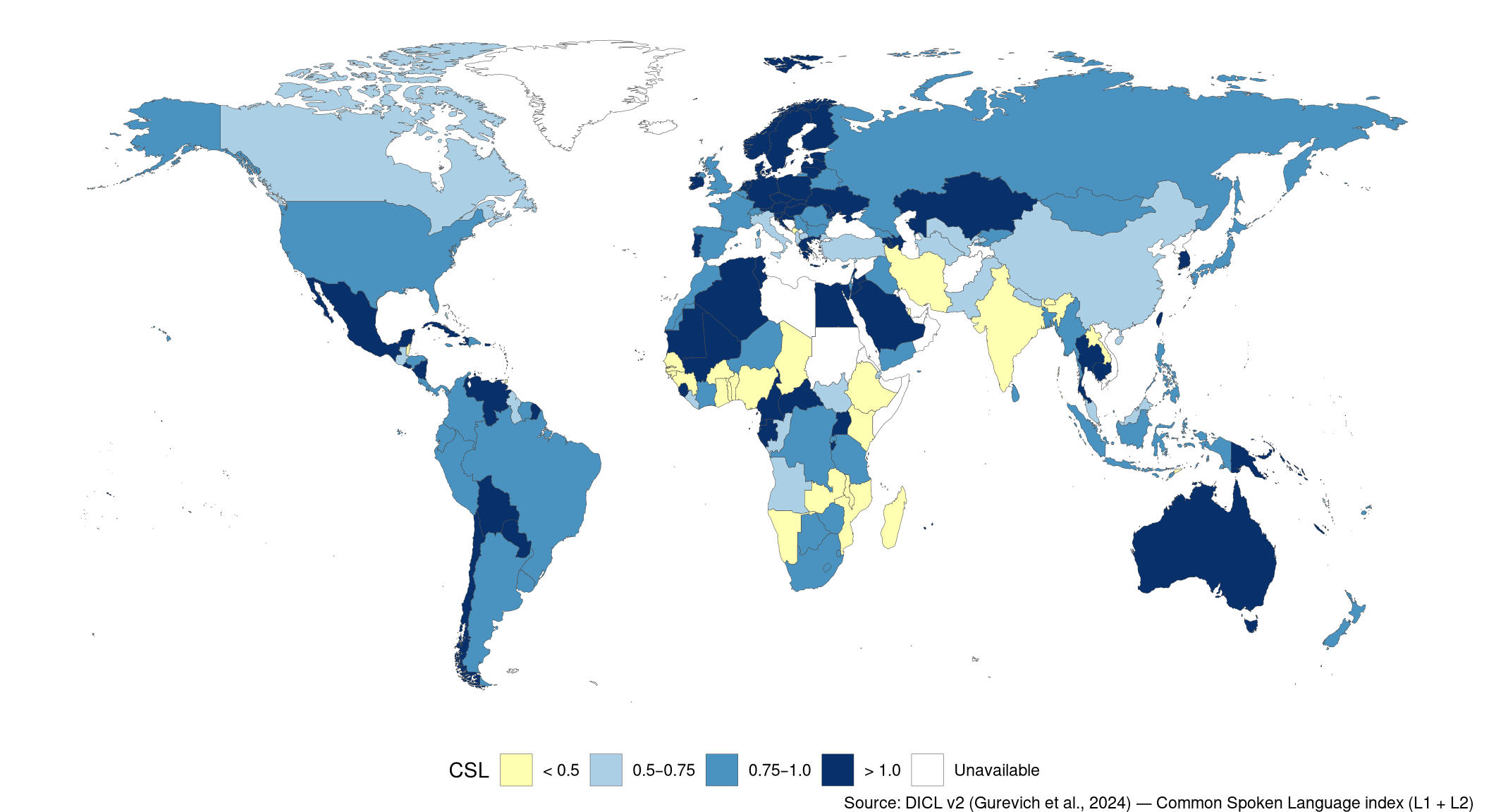
Non-strategic explanations
Initial diversity. Does linguistic diversity now just reflect the linguistic diversity of the past?
Duration of rule. Do you just need the same regime in place for a long time to produce linguistic commonality?
State capacity. Do you need the state to have high extractive capacity in the first place to have a national language?
Problems with the non-strategic explanations
Initial diversity.
- Around 1300, virtually all regions had high linguistic diversity
- Even European states were linguistically diverse until recently
Duration of rule.
- Long rule, low penetration of colonial language: Macau, Philippines
- Short rule, high penetration of new language: Hebrew in Israel
State capacity.
- High capacity, low commonality: Canada, China
- Low capacity, high commonality: Tanzania, Indonesia, Central America
Linguistic commonality as a strategic choice
Darden and Mylonas: linguistic commonality results in part from deliberate decisions by states — nation-building through national schooling
Puzzle from the SSW perspective: why wouldn’t every state do this?
Key insights:
- It’s costly to set up a national education system
- The benefits vary depending on threat conditions
- High threat \(\leadsto\) need to provide for national defense
- Low threat \(\leadsto\) maybe better to tax less + ask less of public
Alternatives
Discussion question
We’ve seen two accounts of how a state can build nationalism:
- Sambanis et al: Victory on the battlefield
- Darden and Mylonas: National schooling
What other mechanisms could the state use to build national sentiment? When would they be preferable to these?
The hypotheses
High external threat \(\rightarrow\) mass national schooling \(\rightarrow\) greater linguistic commonality
- States in competitive environments invest in nation-building
- Produces durable linguistic homogeneity
Low external threat \(\rightarrow\) no incentive to nation-build \(\rightarrow\) lower linguistic commonality
- Costs of nation-building more likely to outweigh benefits
- Education left to missionaries, churches, or other non-state actors
- Result: diverse educational systems, multiple languages
Evidence
Regional patterns
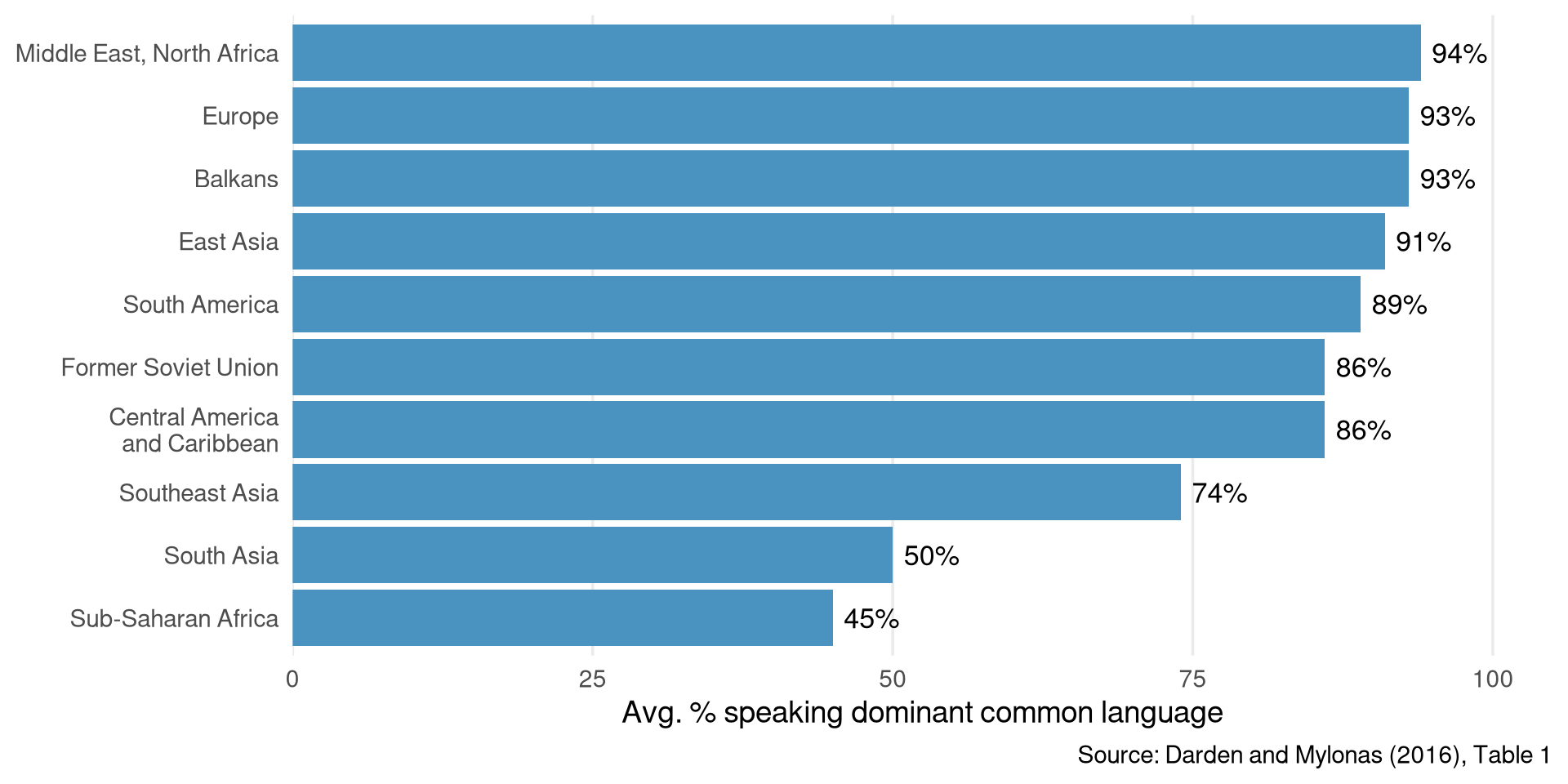
Regional patterns and the theory
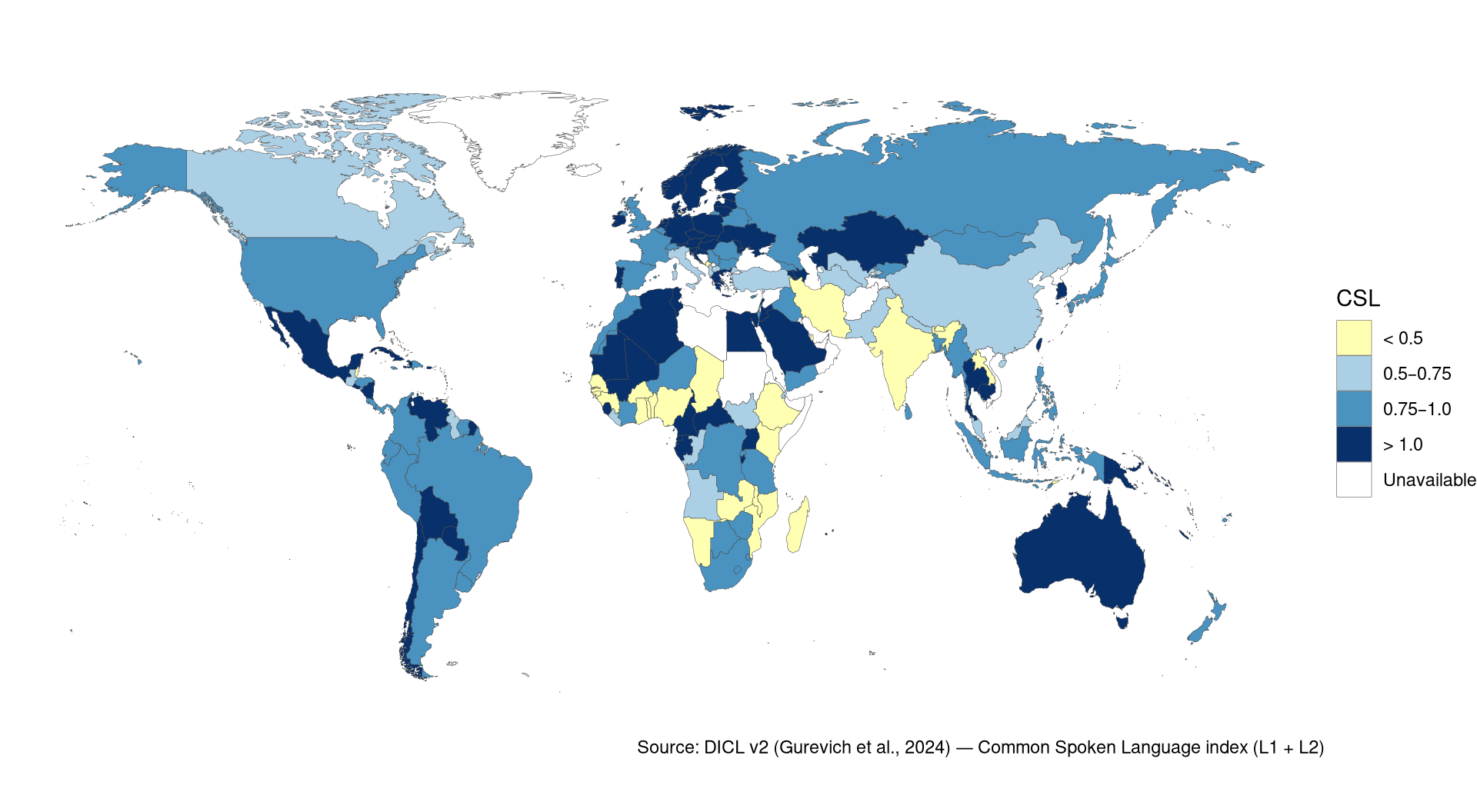
High commonality where there was high interstate competition (Europe, East Asia); low where borders were externally guaranteed (Sub-Saharan Africa)
Sub-Saharan Africa
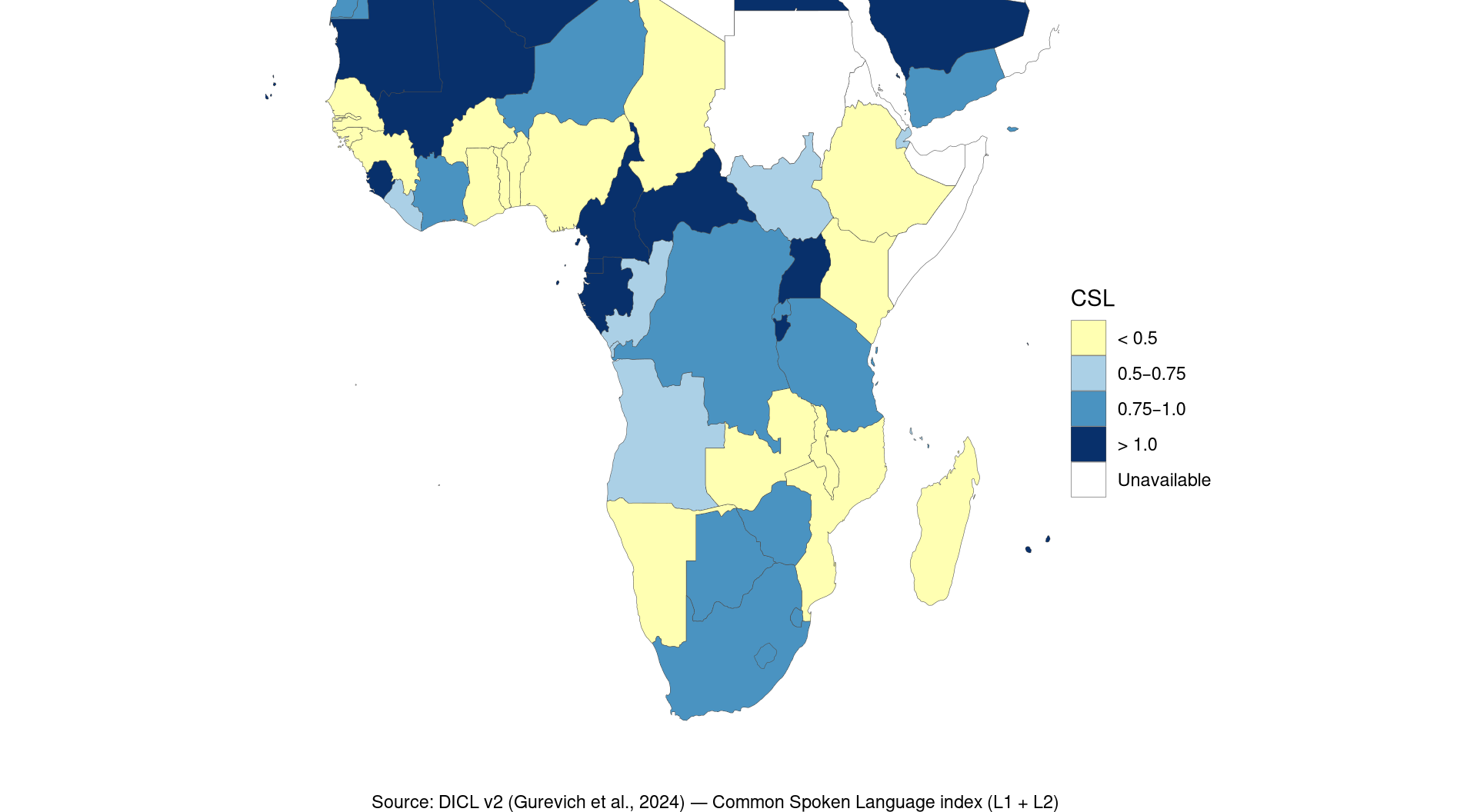
Why Sub-Saharan Africa is so low
The D&M explanation:
- Treaty of Berlin (1884–85): Great Powers “froze” state borders
- Post-colonial African elites colluded in 1964 to preserve existing borders
- Result: near-absence of interstate war, boundary change, and external threat
Without external threats, no strong incentive to nation-build
- Education often left to missionaries — who taught in local languages, not national ones
- Multiple languages cultivated, reinforcing ethnic and regional identities
- Colonial and post-colonial decisions to delegate schooling \(\rightarrow\) linguistic heterogeneity
Case study: Indonesia (high threat)
Indonesia at independence (1949):
- 75.5 million people across 18,000 islands
- 750+ languages spoken; most common (Javanese) was a minority language
- Bahasa Indonesian — the language of the nationalist movement — spoken by under 5%
- GDP per capita: $803; literacy: 15–20%
Not an obvious candidate for linguistic homogenization — yet it happened
Indonesia’s external threats
(a) Threat of military conquest
- Won independence through war against the Dutch and British
- Borders remained contested; boundary disputes resolved by military action
(b) Threat of externally supported secession
- Dutch promoted “Pasundan” state (Balinese, Ambonese, Moluccan nationalism)
- Japanese occupation had mobilized ethnic divisions
- Cold War fears: links between ethnic Chinese and PRC; rivalry with Malaysia
- Post-colonial meddling by former imperial powers
Indonesia’s response: mass schooling in Indonesian
Indonesia pursued nation-building through schools
- 1950s: mass schooling and literacy campaign — adult education, “people’s libraries,” thousands of new schools
- Indonesian established as the sole national language of instruction (beyond Grade 3)
- By 1952–53: 6.4 million of 12.3 million school-age children enrolled (52%)
Results:
- Literacy: 42.9% (1961) \(\rightarrow\) 59.6% (1971) \(\rightarrow\) 81.5% (1990) \(\rightarrow\) 90%+ (2004)
- By 2010: 88% of 237 million people were Indonesian speakers
- Linguists describe an “epidemic language shift” — Indonesian as a “killer language”
Difficulty: Southeast Asia
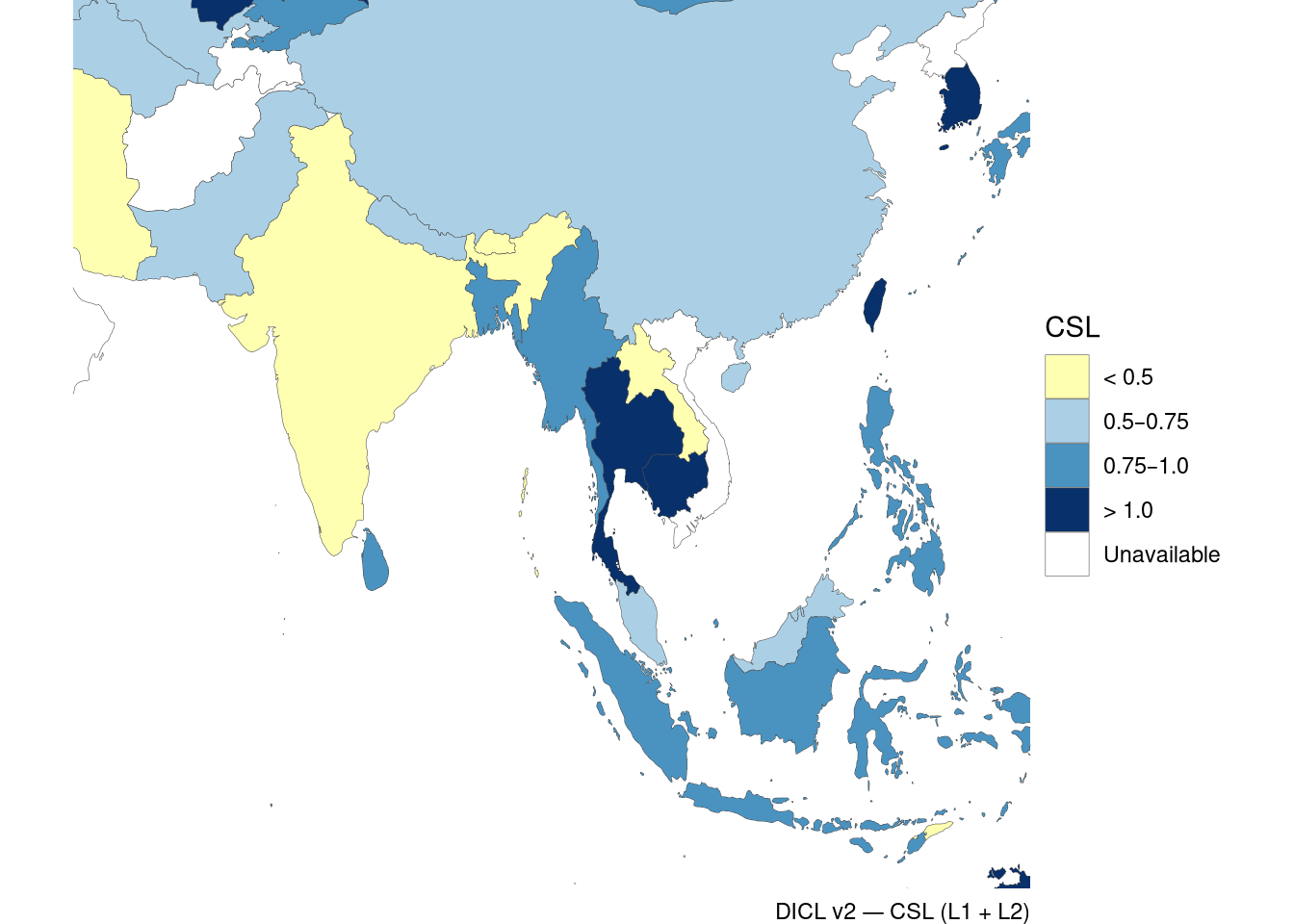
What explains the variation within Southeast Asia? Is it really related to external threats?
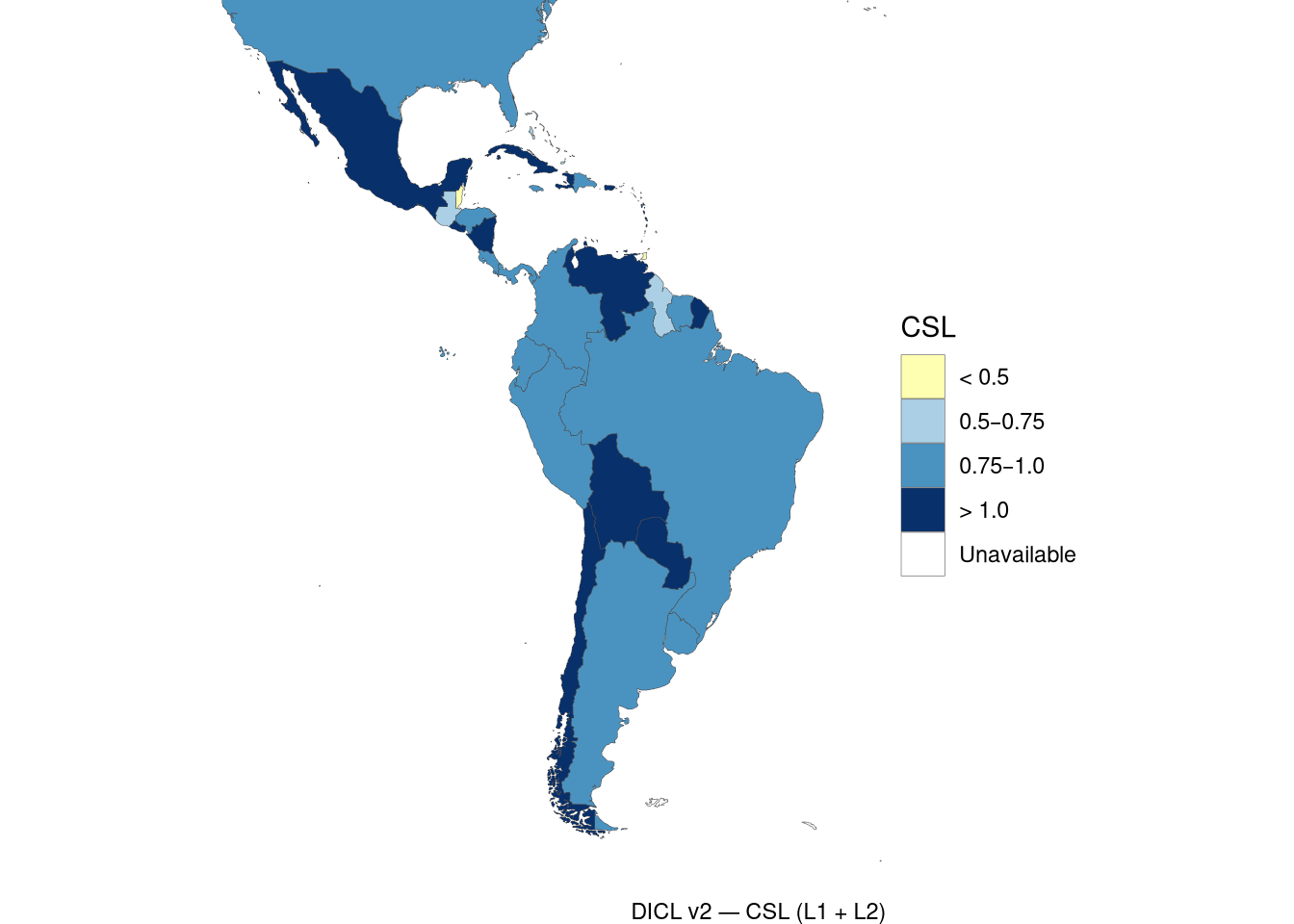
Difficulty: Latin America
Why is Latin America uniformly high?
- Borders have been very stable since the 1830s — similar to Africa
- Interstate war has been rare
- Thies: variation within region in rivalry
- Yet linguistic commonality is very high throughout the region
Holding alternatives to a higher standard?
(c) D&M seem to hold their “alternative explanations” to a higher evidentiary standard than their own theory
Their argument structure:
- Initial diversity “doesn’t explain it” because Europe was diverse too
- But this is about relative levels — some places were more diverse
- State capacity “doesn’t explain it” because weak states can homogenize
- But this doesn’t mean capacity is irrelevant
- Duration of rule “doesn’t explain it” because of counterexamples
- But there are counterexamples to the threat theory too
Wrapping up
What we did today
- The puzzle: wide cross-national variation in linguistic commonality
- Can’t be fully explained by initial diversity, state capacity, or duration of rule
- D&M’s theory: external threats drive nation-building
- Threatened states invest in mass schooling with national content
- Secure states outsource education \(\rightarrow\) persistent heterogeneity
- Mechanism: national schools
- Evidence
- Regional patterns align broadly with the theory
- Indonesia (high threat) vs. Congo/Zambia (low threat) as key comparison
- Some puzzles remain: Latin America, Southeast Asia
To do for next time
Reminder: No lectures next week (Apr 6–8). Final paper consultations instead.
https://calendly.com/brenton-kenkel/wasd-paper-consultations
Monday, Apr 13. Read Brewer, The Sinews of Power.