Nation building and war
PSCI 2227: War and State Development
March 30, 2026
In case you don’t read your email
- No lectures next week (Apr 6–8)
- Replaced by final paper consultations
- https://calendly.com/brenton-kenkel/wasd-paper-consultations
- Reading schedule changed
- Weds 4/1: Darden and Mylonas
- Mon 4/13: Brewer
- Weds 4/15: Chen
- Revision memo templates now posted in Brightspace
Recap
Last time. Nationalism as a political ideology
- Relatively new, past couple hundred years
- Imagined, limited, sovereign (Anderson)
Today. Sambanis, Skaperdas, Wohlforth, “Nation-Building through War.”
Today’s agenda
- The nation-building problem
- How war builds nations (and thus states)
- …and how that in turn makes war
The nation-building problem
Alternatives to national identity
If people don’t identify with the nation, how do they identify?
One alternative: sub-national identity
- City, state, province, etc.
- Particularly plausible when country has been built from pieces
Another alternative: identities that don’t correspond to borders
- Religious identity
- Ethnic/linguistic identity
Nation-state’s challenge: make nationalism more appealing than alternatives
Sub-national identities in unification-era Germany
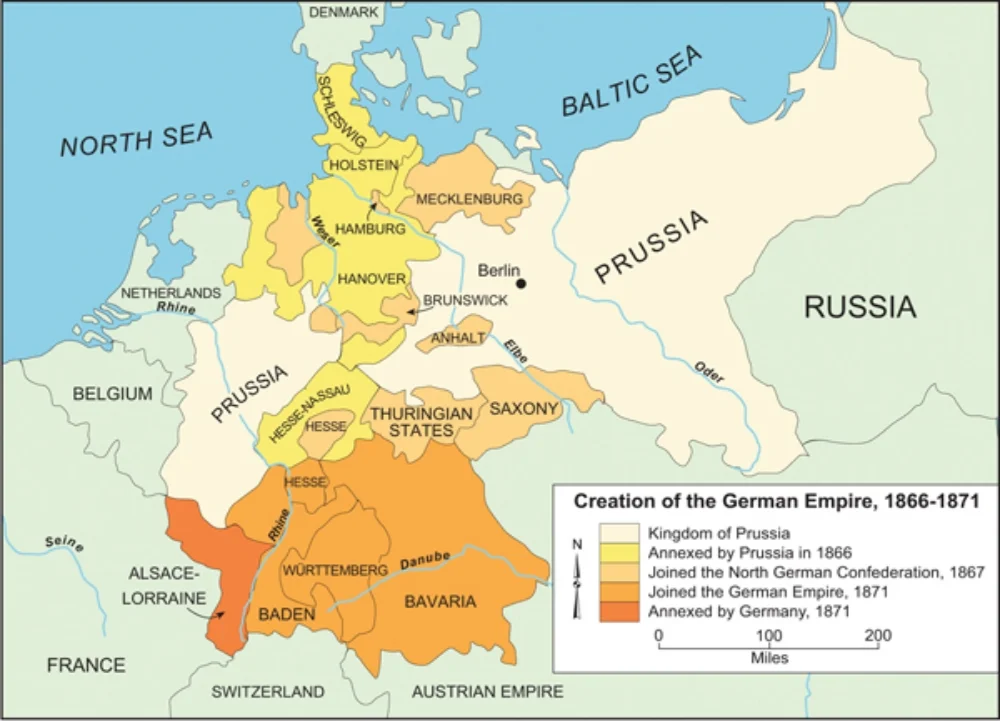
Bismarck’s challenge: how to bring the south into a German identity?
Ethnic and religious identities in post-2003 Iraq
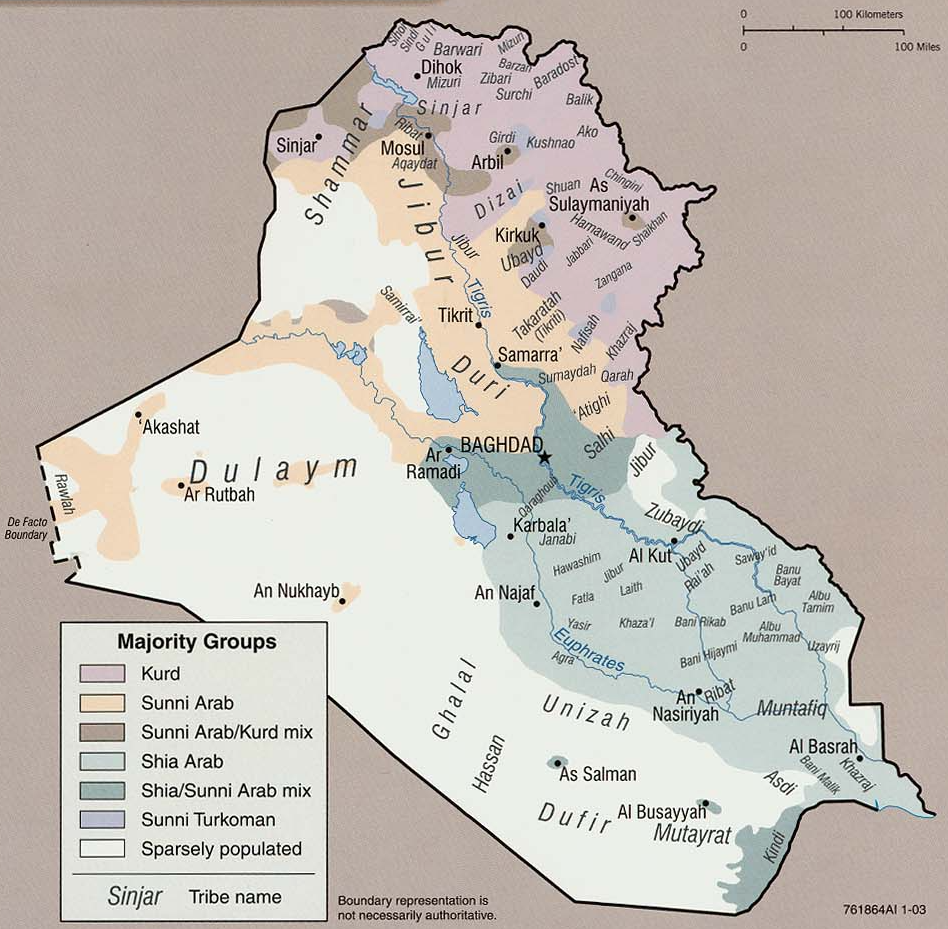
US occupation’s challenge: how to foment functioning Iraqi democracy?
Consequences of non-national identification
When people identify with sub-national groups instead of the nation, two bad things happen from the state’s perspective:
1. Undermines public good provision
- Why invest in national infrastructure, defense, education if you only care about your own group?
- State capacity suffers when groups don’t cooperate
2. Fuels internal conflict
- Groups compete over resources, territory, political power
- Fighting is costly — wastes resources that could go toward productive activity
The reinforcing cycle
    ┌─────────────────────────────────┐
    │   Sub-national identification   │
    └──────┬───────────────┬──────────┘
           │               │
           ▼               ▼
    ┌────────────┐  ┌──────────────┐
    │ Low state  │  │   Internal   │
    │ capacity   │◄─┤   conflict   │
    └─────┬──────┘  └──────┬───────┘
          │                │
          └────────┬───────┘
                   │
                   ▼
          ┌─────────────────┐
          │ Weaker national │
          │    identity     │
          └─────────────────┘
How war builds nations
International level: status competition
States exist in a competitive, anarchic international system
- Competing over territory, prestige, influence
- A state’s status depends on its performance relative to rivals
Victory in war raises a state’s international status — defeat lowers it
Why does this matter domestically?
- People like to identify with high-status groups
- More attractive to identify with a nation that’s successful in battle
National level: the identification shift
When the nation’s status rises after a military victory, the calculus of identification changes
Each group weighs:
- Status bonus: prestige of identifying with a winning nation
- Distance cost: cultural/social distance from the national identity
After victory: status bonus goes up \(\Rightarrow\) more people identify nationally
- Even groups that were previously non-nationalist may shift
- The perceived benefits of being part of the nation outweigh the costs of giving up group identity
Individual level: effort allocation
Key idea in SSW: identification changes individual behavior, not just attitudes
How I think about the individual decision calculus:
| Activity | Description | Effect on the state |
|---|---|---|
| State capacity | Invest in public goods, institutions | Great for the state |
| Private production | Work for personal gain | Good — taxable |
| Conflict | Fight other groups for resources | Bad for the state |
Effects of nationalism:
- State capacity building \(\uparrow\)
- Conflict with other groups \(\downarrow\)
Nation-building as a cause of war
Tilly vs. SSW
Tilly’s story is essentially chronological
- War happened \(\rightarrow\) states that built capacity survived \(\rightarrow\) those states made more war
- A pattern, but not a reason — rulers don’t sit around thinking “I should start a war to build state capacity”
SSW add strategic nation-building
- Forward-looking rulers anticipate nation-building if victorious
- Makes war more attractive than it would be based on territorial gains alone
How nation-building can break the bargaining range
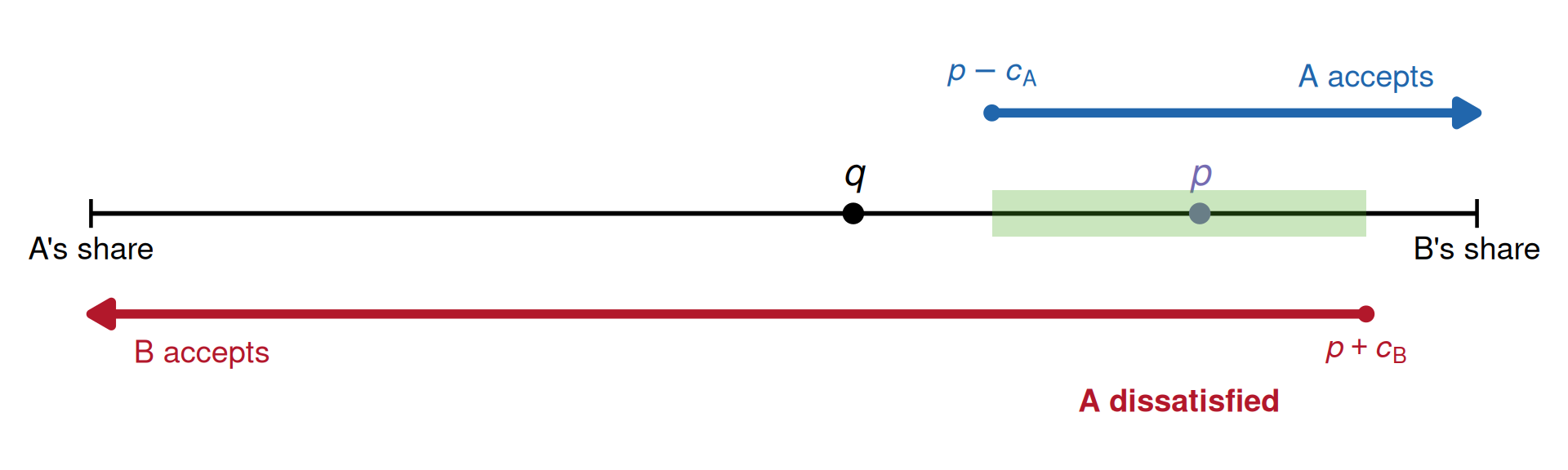
Remember back to the bargaining model of war
War costly \(\leadsto\) bargain available
But the “costly” assumption can break if victory builds one state, but defeat won’t break the other
The Bismarck strategy
Prussia’s problem: Southern German states resisted unification
- Anti-Prussian sentiment was growing through the 1860s
- Soft approaches (customs union, economic incentives) were failing
- Bismarck: “German unity is likely to be fostered by violent events”
Bismarck’s solution: Engineer a crisis with France
- Provoked a war that he expected Prussia to win
- Deliberately framed the conflict as a Franco-German status contest
- Goal: victory over France would make “Germany” a high-status identity that Southerners would want to join
The war’s effects on identification
War had exactly the effects SSW’s model predicts
- Large-scale mobilization fostered a sense of shared purpose
- Southern populations that had elected anti-unification parties in 1868–69 now demanded to join the Reich
- Bavaria’s government had to bow to popular nationalist sentiment
Result was massive state-building
- North German Constitution extended to the new Reich
- New institutions: central bank, common currency, unified legal system
- Investments in social welfare and public education
- States that had initially resisted (Bavaria, Württemberg) accepted unification of German laws
Wrapping up
What we did today
- The nation-building problem
- Sub-national identities undermine public goods and fuel conflict
- These two problems reinforce each other in a vicious cycle
- How war builds nations
- Victory \(\rightarrow\) higher national status \(\rightarrow\) national identification
- National identification \(\rightarrow\) more state capacity, less conflict
- SSW vs. Tilly on why rulers start wars
- Tilly: war \(\rightarrow\) state building is a historical pattern
- SSW: war \(\rightarrow\) nation building is a strategic choice by forward-looking rulers
- Bismarck and the Franco-Prussian War as the key illustration
Rest of this week
Reminder. https://calendly.com/brenton-kenkel/wasd-paper-consultations
Tomorrow. My office hours, 2:00–3:30pm.
Wednesday. Read paper by Darden and Mylonas on territorial integrity and mass schooling.
Friday. Seungho’s office hours, 3:00–4:30pm.