War and revenue: Statistical evidence
PSCI 2227: War and State Development
Prof. Brenton Kenkel
Vanderbilt University
February 18, 2026
Hypotheses
What are Karaman and Pamuk going to collect data on?
- More intense war participation \(\leadsto\) more fiscal capacity
- Consistent with Tilly, Thies, Levi
- More urbanized society \(\leadsto\) more fiscal capacity
- Consistent with Spruyt, Abramson
- More representative government \(\leadsto\) more fiscal capacity? or less?
- “More” consistent(ish) with Dincecco and Wang
- But also compelling reasons to believe “less”
- Interactions — each factor might alter the effects of others
Data
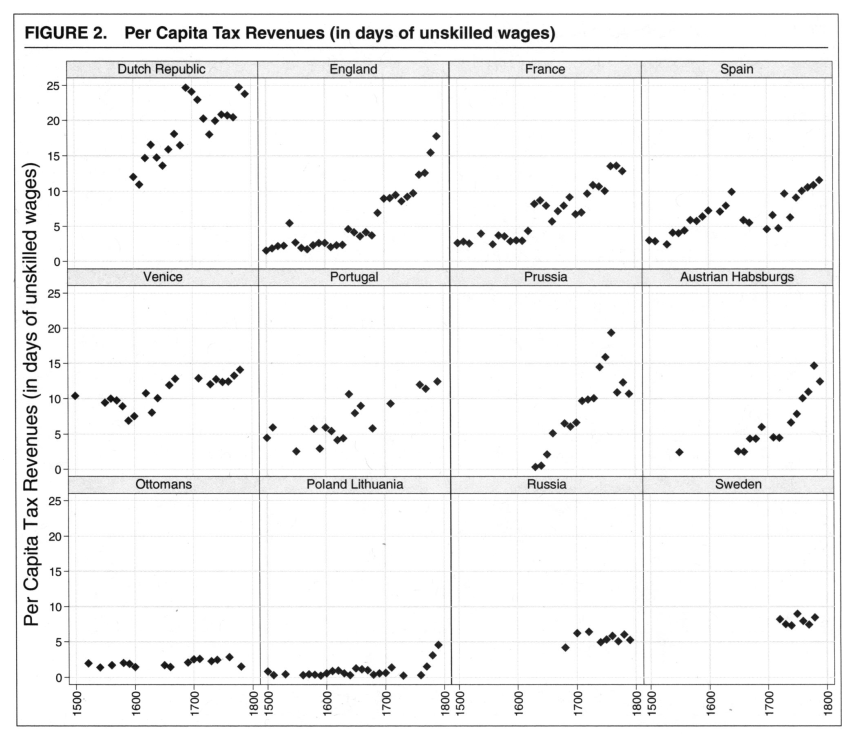
Dependent variable: fiscal capacity
- Raw measures: total and per capita tax revenue by silver weight
- Preferred measure: per capita tax revenue, in days of unskilled labor
- roughly, how many days would you have to work an unpleasant job in a city to pay off the average annual tax bill?
Independent variables:
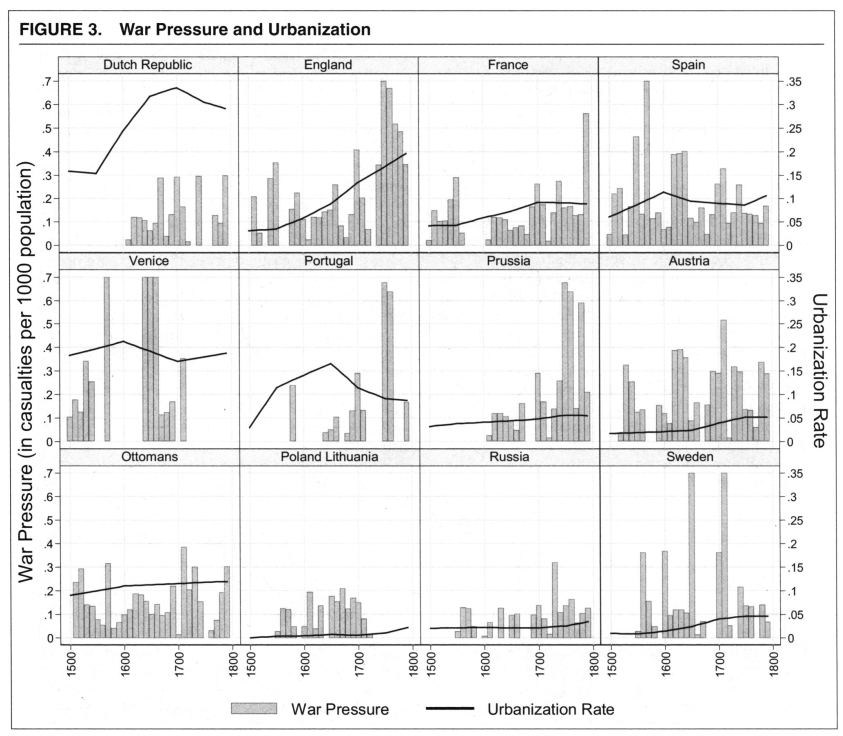
- War intensity — “apportioned” casualties per thousand
- all casualties divided evenly across sides, to proxy for intensity
- Urbanization — share of population living in cities w/ 10k+ residents
- Representation — responsibility/frequency of a national assembly
Differences in fiscal capacity
![]()
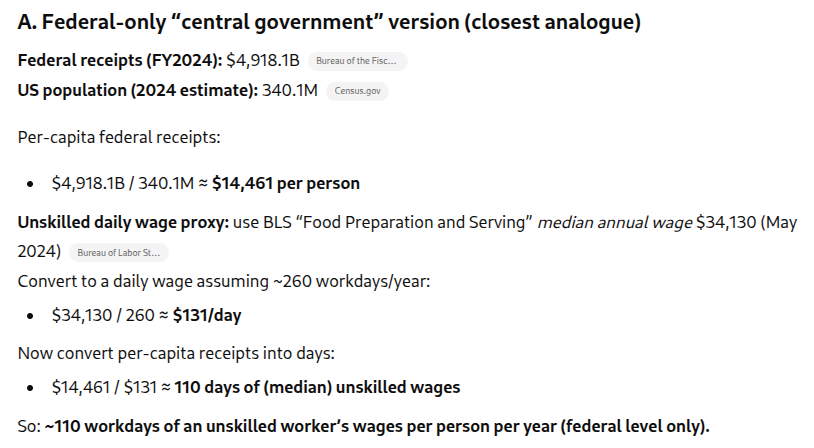
Fiscal capacity: Present-day comparison
![]()
Important caveat for real-world impact: US taxes now much more progressive than European state taxes in 1500–1800
Differences in war intensity (and urbanization)
![]()
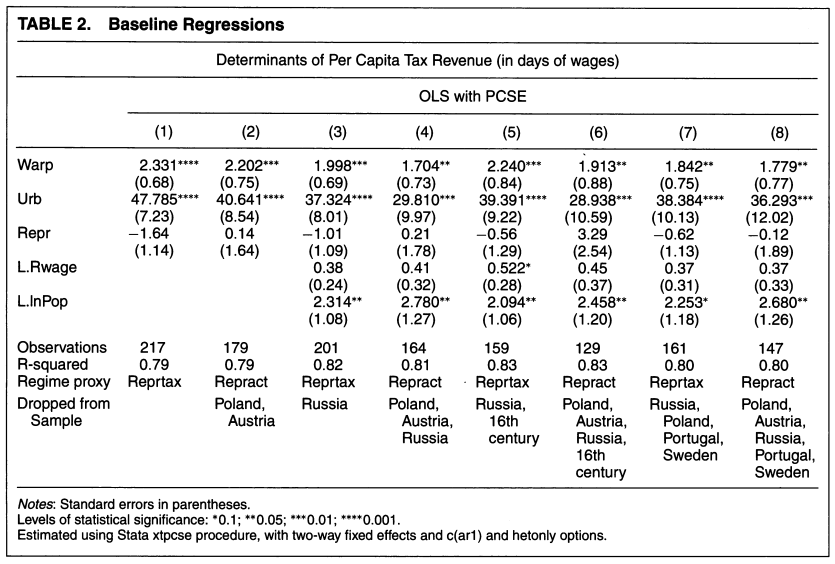
The key correlations
![]()
War and urbanization correlated with higher revenues
No consistent pattern with representation
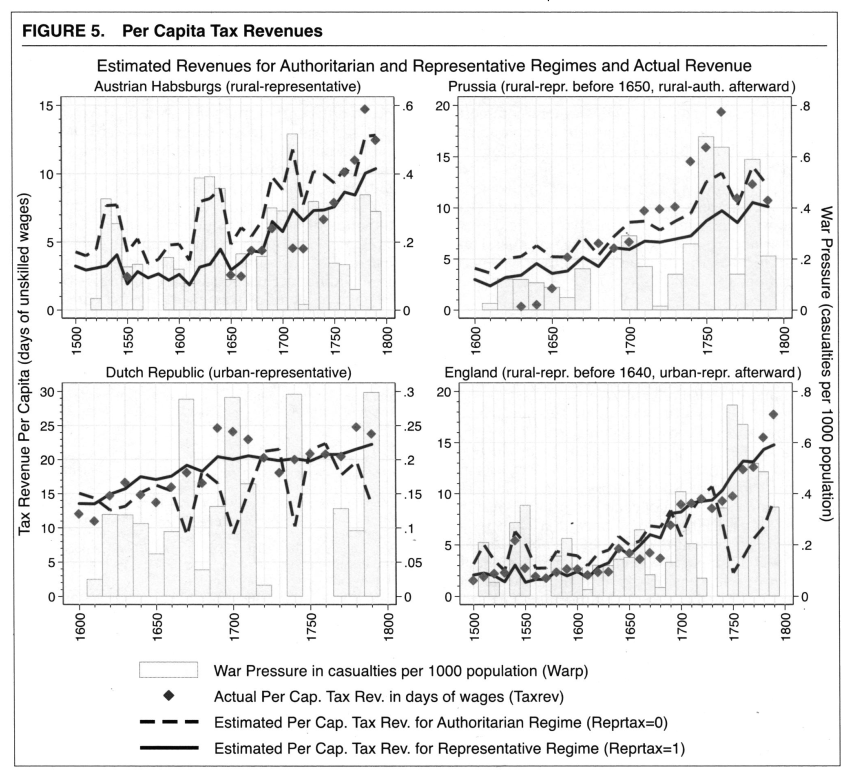
What’s the deal with representation?
Karaman and Pamuk’s basic premises:
- Representation enables elite coordination and cooperation
- Urban elites are favorable to central states, rural elites aren’t
Leads them to expect conditional effects of war pressure
- urbanized, representative \(\leadsto\) war makes the state
- rural, autocratic \(\leadsto\) war also makes the state (diff reasons)
- war doesn’t make state in urban/autocratic or rural/representative
(my take: insufficient data to make solid inferences about such a thin-sliced argument…)
Urbanization, representation, and war: Nuances
![]()
What we did today
- Levi’s theory of rulers and revenue
- Rulers must compel or cooperate with elites to raise money
- Relative bargaining power is key determinant of fiscal capacity
- War (mostly) shifts that power toward the ruler
- Karaman and Pamuk’s statistical evidence
- War pressure + urbanization increased fiscal capacity in Europe
- Effects of representative institutions were … complicated
To do for next time
Project proposal due Friday at 11:59pm
Need help before then?
For Monday read Queralt 2019, “War, International Finance, and Fiscal Capacity in the Long Run”