Exit, voice, and war in Europe vs. China

PSCI 2227: War and State Development

Prof. Brenton Kenkel

Vanderbilt University

February 9, 2026

Recap

Latin America as a “hard case” for Tilly outside Europe

  • Few interstate wars, stable borders, yet sovereign states persisted
  • Thies’ alternative: interstate rivalry (threat of war) as driver of statebuilding
  • Looked at the data: wars, rivalries, and tax ratios across South America 1900–2000
  • Little robust evidence that war or rivalry drove state capacity in the region
  • Takeaway: Tilly is a much better guide to Europe than to Latin America

Today’s agenda

  1. The ruler–elite relationship: why even kings need help
  2. Exit, voice, and loyalty as responses to ruler policy
  3. How the exit option shaped state development differently in Europe vs. China

Rulers, elites, and war

What a ruler wants

Louis XIV, king of France, 1643–1715

Key objectives for a ruler

  1. Stay in power

    • Internal threats
    • External threats
  2. Consolidate control

    • Neutralize repeated threats
    • Raise more revenue
  3. Expand territory

    • More resources to maintain power
    • Greater buffer vs external threats

Even kings need support

Monarch’s goals require cooperation from critical mass of elites

  • Feudal era: Major landholders
  • Modern period: Also major merchants, bankers
  • These days: Also highest-ranking officers in standing military

Why can’t they just govern on their own?

  1. Need manpower

    • Defense against internal and external threats
    • Agricultural economies \(\leadsto\) landholders must give up some labor
  2. Need money

  3. Elites best suited to pose internal threat (esp. historically)

Why elites might withhold support

If the king asks for money to build up the army, why would the elites say no?

(Take a minute to chat about this)

Is the cost worth the benefit?

  • Pressing external threat \(\leadsto\) common interest in defense

  • Interests not so clearly aligned in case of offensive wars

  1. Will today’s military buildup weaken the elite’s power too much tomorrow?

    • Military is “dual use” — fighting abroad, coercion at home
  1. Is the money really for the public defense?

    • “Incentive compatibility” problem: King wants revenue no matter what

    • e.g., Charles I and ship money in the 1630s

Exit, voice, and loyalty

How can the elite respond when they don’t like what the ruler is doing?

Exit. Move oneself and/or one’s wealth out of the country.

  • Problem 1: Can these things be moved?
  • Problem 2: Where to go? Will it be any better?

Voice. Actively protest unwanted policies.

  • Problem 1: Will the ruler listen?
  • Problem 2: Costs and risks of a repressive/coercive response

Loyalty. Push for improvement working within the system.

  • Problem: How to change ruler incentives without causing some pain?

Ruler strategies to manage elite dissent

Optimal strategy in part depends on anticipated mode of dissent

Anticipated elite exit \(\leadsto\) “carrot” incentive to stay

  • Make the loyalty option more attractive
  • Short run concessions: favors, privileges, tax breaks
  • Long run concessions: institutionalized power sharing
  • Problem (especially for long run): credibility of ruler’s promise

Anticipated elite voice \(\leadsto\) “stick” of repression (preventive or reactive)

  • Punish dissenters for interfering with ruler’s policy
  • Problem 1: Costly and risky escalation
  • Problem 2: Might just push elite to exit if possible

Predictions about war and ruler-elite relations

Where elite exit options are good:

  1. War threats \(\leadsto\) ruler concessions to elite
  2. Long run outcome: power sharing

Where elite exit options are bad:

  1. War threats \(\leadsto\) repression or temporary co-optation
  2. Long run outcome: coercive central state

Lingering question — how do we know how good or bad the exit option is?

Representation in Europe versus China

Key question

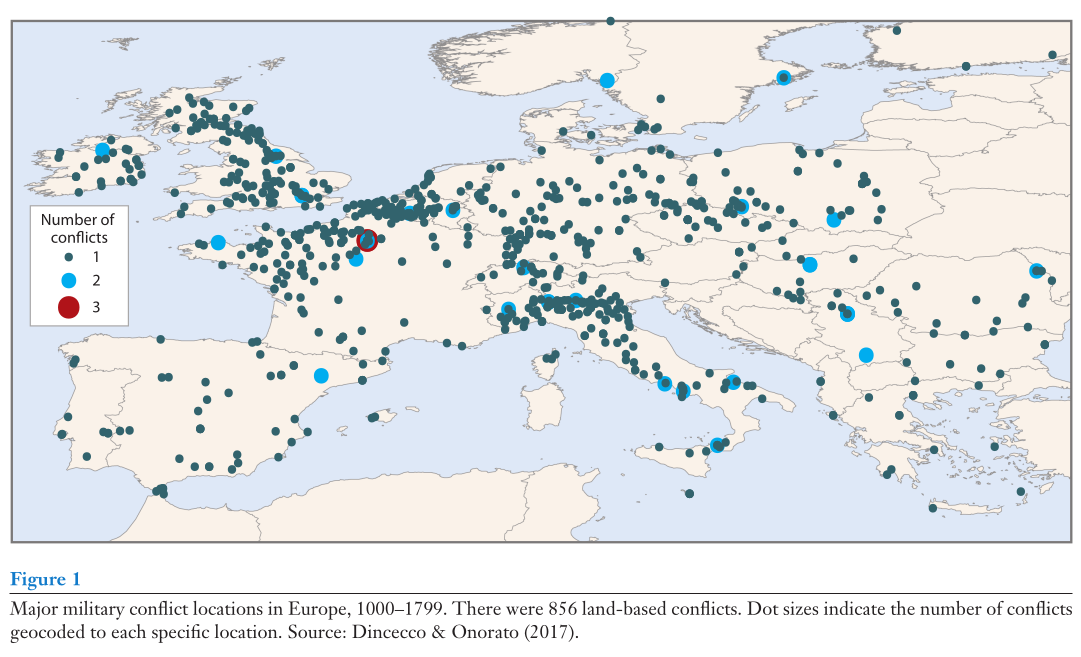
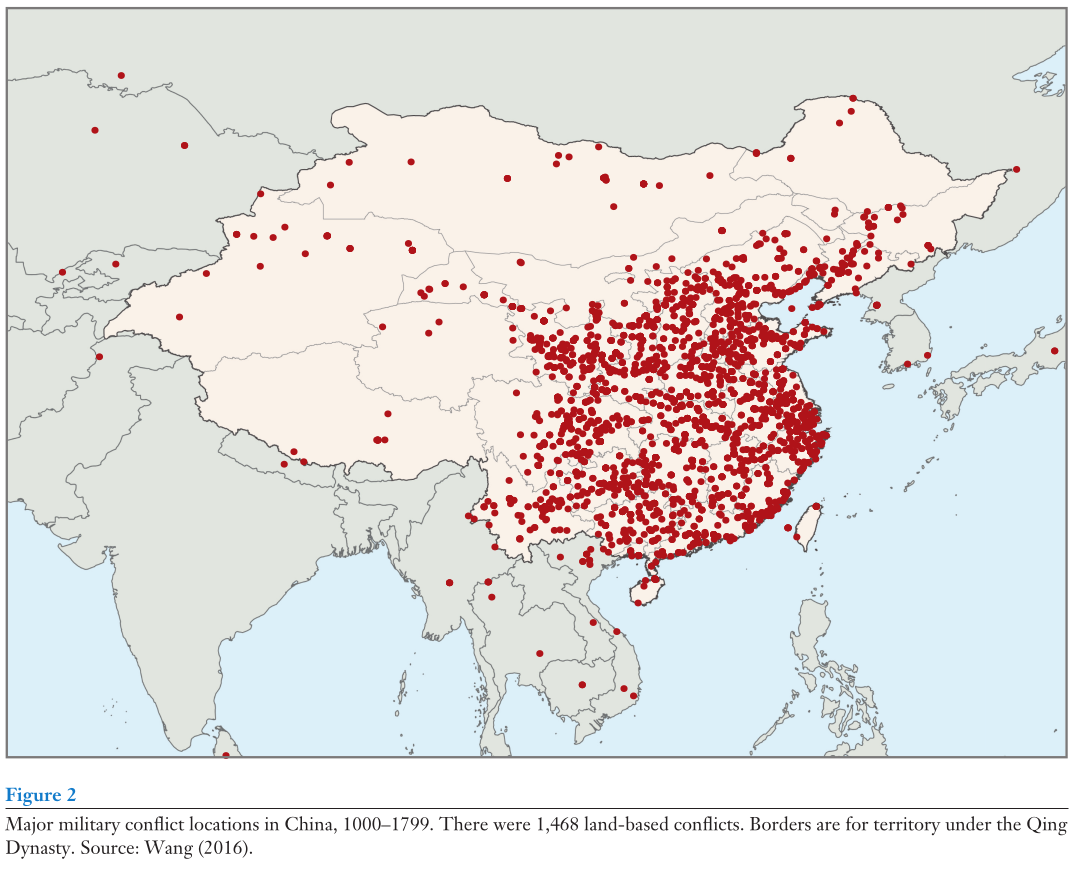
Between 1000 and 1800, Europe and China both experienced plenty of war

Yet European states developed very differently from China

  • More power sharing with elites, less coercion
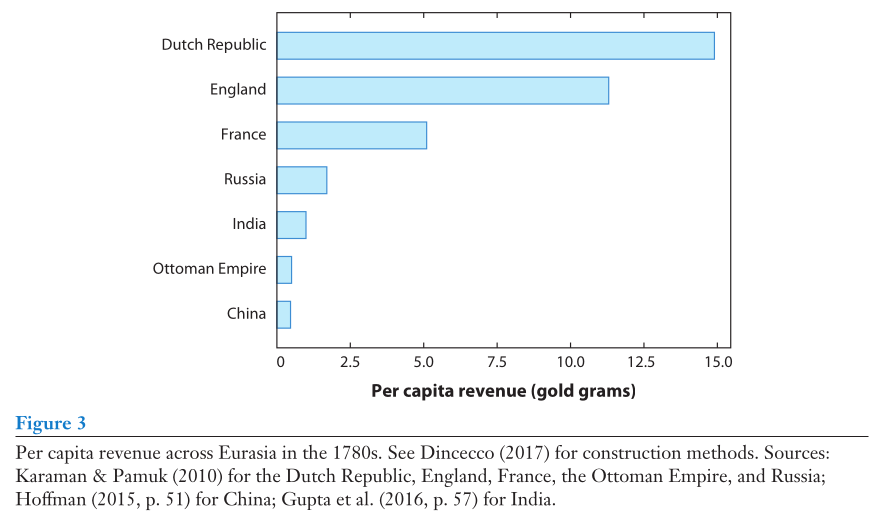
  • Greater extractive capacity

What does this tell us about the role of war in state development?

Fact patterns: War

Fact patterns: War
Fact patterns: War

Lots of wars both places — but important differences on closer look

  1. Nature of war
    • Europe: majority were battles/sieges between interstate rivals
    • China: majority were rebellions or civil wars
  2. Foes in external wars
    • Europe: virtually always other territorial states
    • China: 80% were nomadic invasions

Fact patterns: State development

Institutional power for elites in Europe, no analogue in China
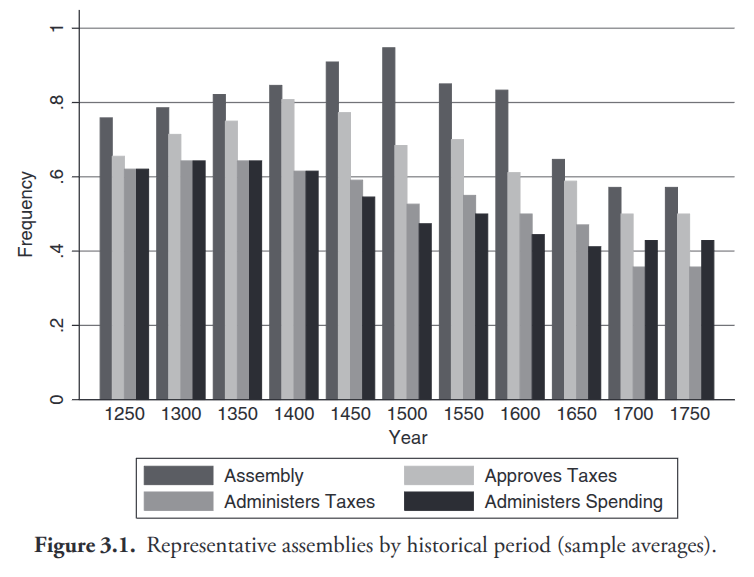
David Stasavage, States of Credit

Fact patterns: State development
Fragmentation and exit options

Key variable according to Dincecco and Wang: political fragmentation

  • Many small countries in Europe (~85 average from 1000–1800)
  • One large centralized state in China

Very different calculations facing dissatisfied elites in these places

  • Unhappy in Europe?
    • Throw in with the rival next door
  • Unhappy in the middle of China?
    • Where else are you going to go?
    • Do you expect the Mongol nomads to help you?

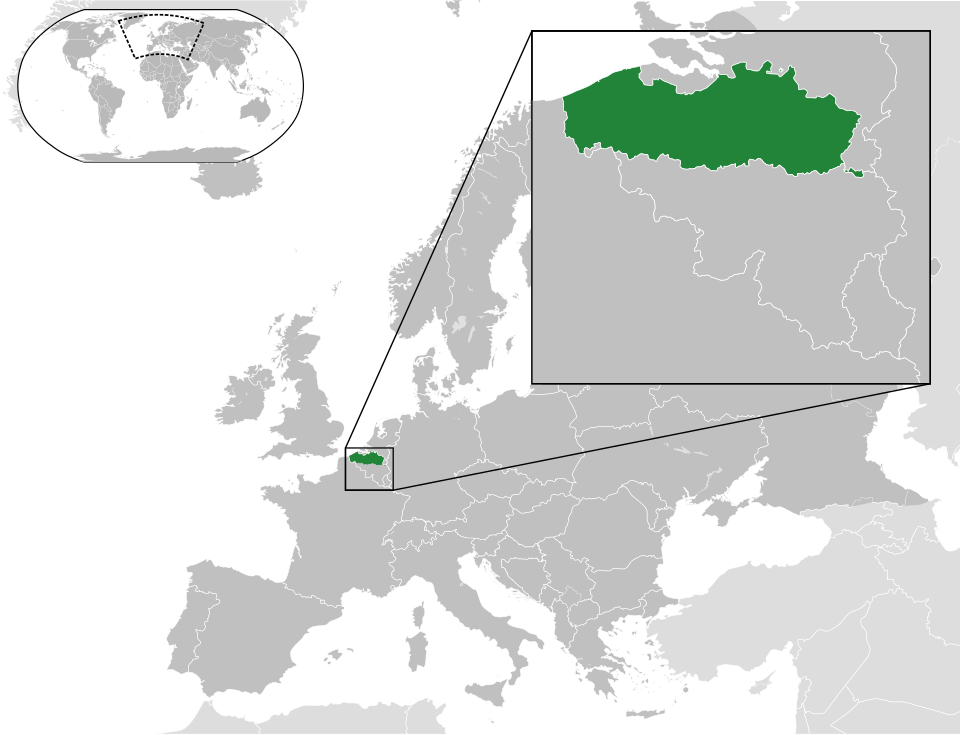
Exit options in Europe: Flanders in the 1300s

Rich and economically important due to textile industry

Technically owed allegiance to France, but imported most wool from England

Political exit: Allied with English early in Hundred Years War, in hopes of securing better long-run treatment

Individual exit: Traders and weavers moved to England or other regional locales
Matching up with theoretical predictions

Europe: elite exit viable due to fragmentation

  • Frequent interstate threats meant states needed money
  • Got it through long-run power sharing arrangements with elites

China: no realistic exit option

  • Conflicts tended to be internal, not external
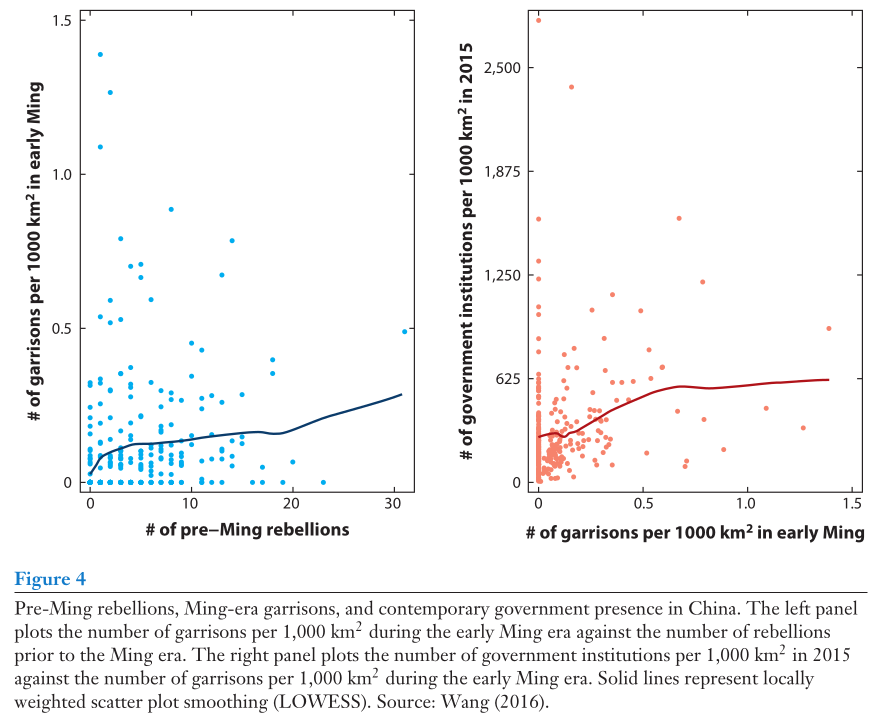
  • State responded with repression, increasing internal military presence
  • …or with temporary buyoffs like altering school quotas

The stickiness of state presence in China
Puzzle: why could the “weaker” states extract more?

China sounds like the stronger state, yet didn’t raise nearly as much revenue from its subjects on a per capita basis

We’ll return to this when we talk about war and parliamentary development

Wrapping up

What we did today

  1. The ruler–elite relationship: why even kings need help
    • Rulers need manpower and money — elites control both
    • Elites may resist if costs outweigh benefits or if military buildup threatens their power
  2. Exit, voice, and loyalty as responses to ruler policy
    • Ruler strategy depends on anticipated mode of dissent: carrots for exit, sticks for voice
    • Availability of options depends on geography, economy
  3. How the exit option shaped state development differently in Europe vs. China
    • Political fragmentation in Europe \(\leadsto\) power sharing
    • Centralization in China \(\leadsto\) repression and coercive central state

To do for next time

No reading for Wednesday! Just keep thinking about paper topics.