Roving and stationary bandits

PSCI 2227: War and State Development

Prof. Brenton Kenkel

Vanderbilt University

January 12, 2026

Approaching the readings

Some advice if you’re struggling with the readings

  • Don’t try to absorb/memorize every detail from every page
  • Two main things to extract from every reading
    1. What is the central argument the author is making?
    2. What are the main pieces of evidence they use to back it up?
  • Look through the reading guide before starting the reading
  • If you’re still struggling through it

Getting AI help on readings

Better than emailing us if — and only if — you want instant answers

Some tips based on my experience:

  • Start a new chat for each different reading (avoid context rot)
  • Upload the PDF alongside your question
  • Use the best models
  • Ask directed questions
    • Worse: “What is this article about?”
    • Better: “What does he mean when he says sufficiently small groups can often organize for collective action?”

Recap

Weber’s definition of the state:

A human community that successfully claims the monopoly of the legitimate use of physical force within a given territory.

Spruyt’s findings on the territorial state’s rise in Europe:

  • Rise in trade \(\leadsto\) feudalism not viable economically
  • Various competitors arose: territorial states, city-states, city-leagues
  • Territorial states won out due to economic + diplomatic advantages

Today’s agenda

The puzzle of state formation — how does a territorial state come into existence in the first place?

  1. Why the “social contract” theory is implausible
  2. Olson’s metaphor of the state as a stationary bandit
    • Transition from roving to stationary banditry
    • The surprising benefits of stationary bandit rule
  3. Sánchez de la Sierra’s evidence for Olson’s theory

Social contracts and the logic of collective action

Social contract theory

“persons are primarily self-interested, and … a rational assessment of the best strategy for attaining the maximization of their self-interest will lead them to act morally … and to consent to governmental authority.”
Stanford Encyclopedia of Philosophy

Government provides defense from bandits, warlords, predators — necessary for any economy

All better off w/ government \(\leadsto\) given the chance, we’d opt into having one
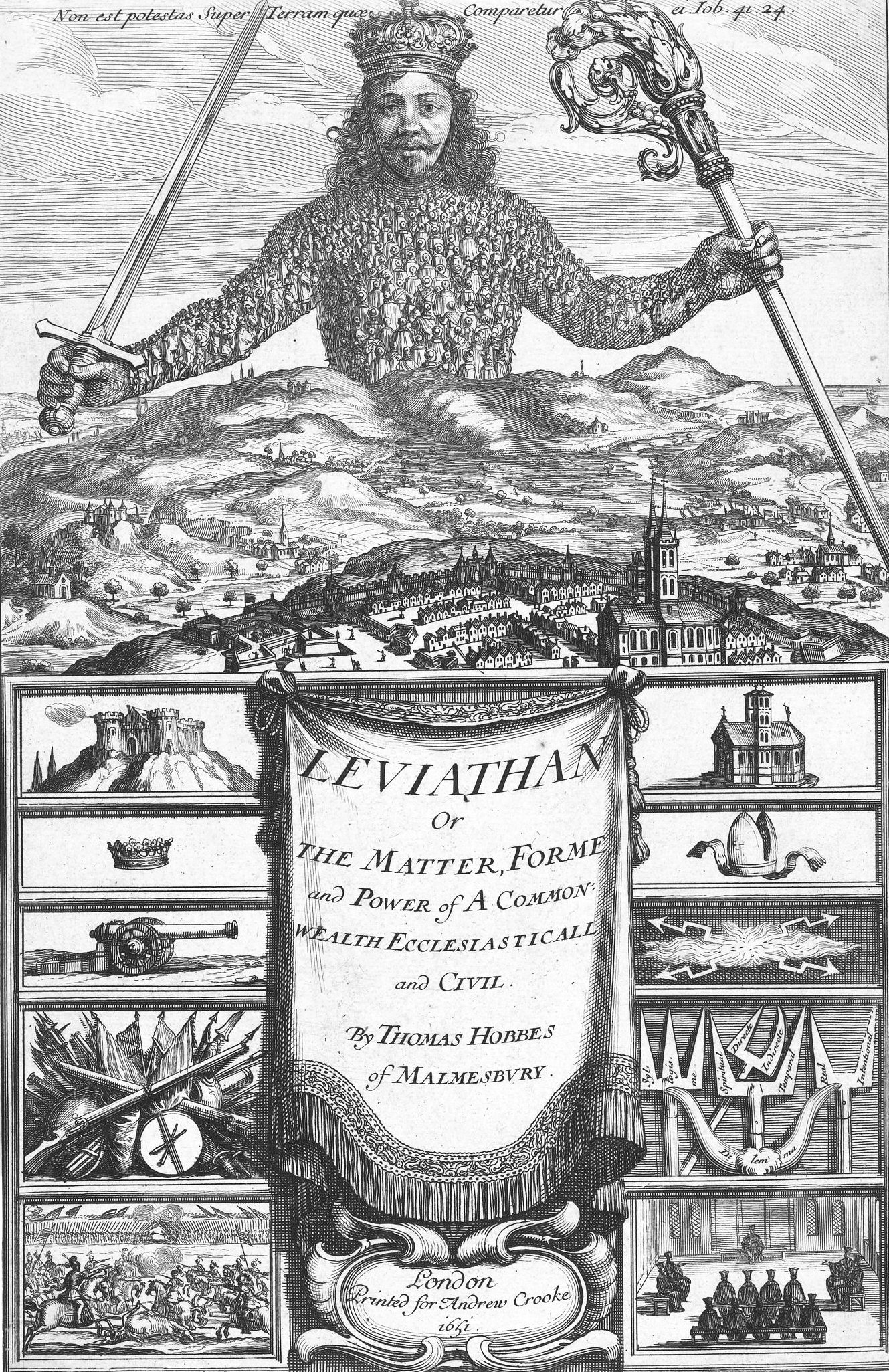
Thomas Hobbes, Leviathan, original frontispiece

Social contract theory: Justification ≠ explanation
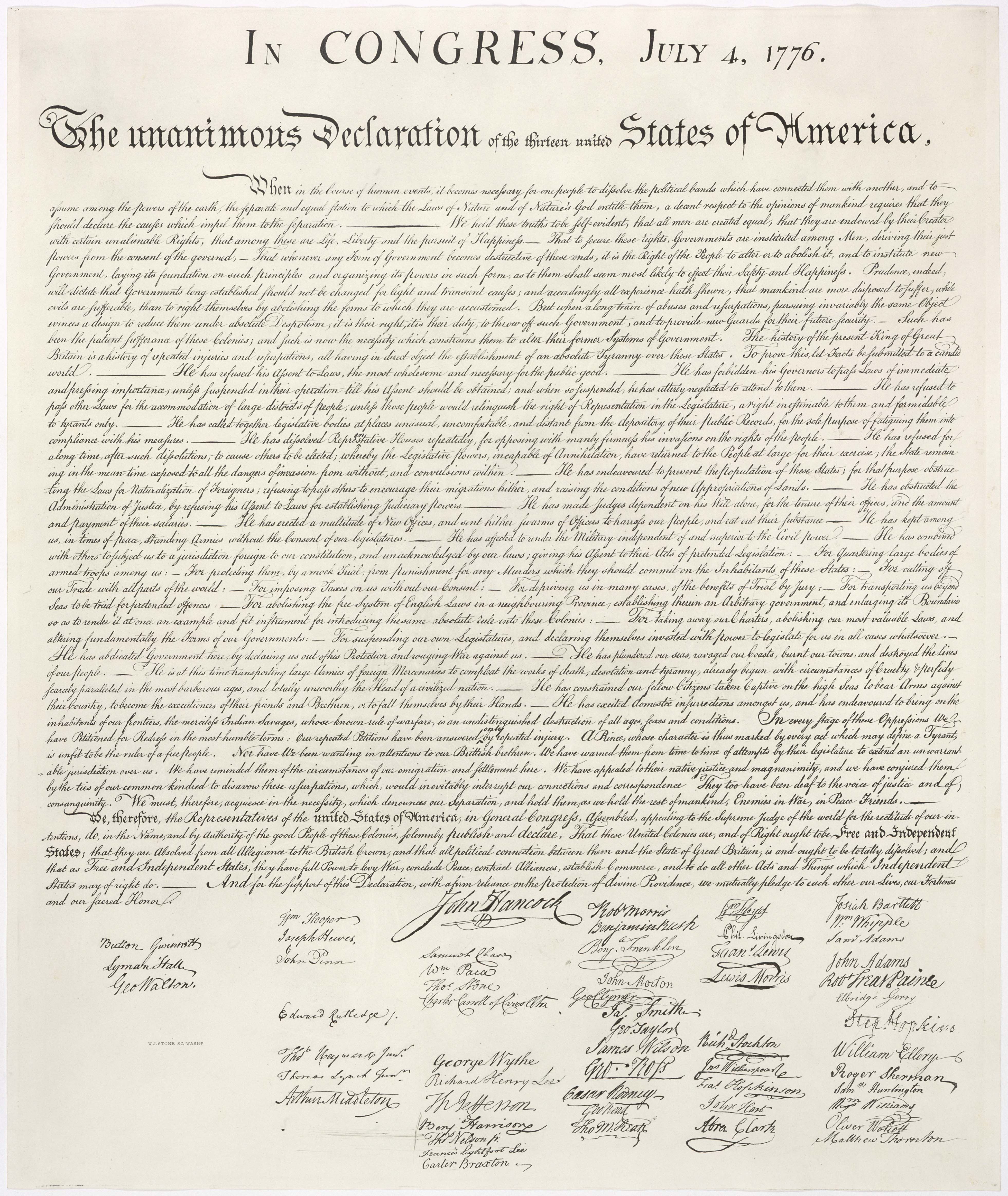
U.S. Declaration of Independence

The “social contract” is a device to justify a monopoly of violence, not explain its existence

Of course you and I never signed a contract!

Not only because our countries were born before we were — it’s just not how states came about

Olson goes further: large states can’t be explained as result of a contract

Collective action and statehood

Key features of a collective action problem

  • Success requires individual contributions
  • If successful, the whole group benefits, even non-contributors

Examples: charity drives, protests, voting, overfishing/overhunting, carbon emissions reduction, arms races, many many many more

State formation as a collective action problem

  • All in society benefit from defense + rule of law
  • But there are individual costs to provide these
    • Paying taxes, or otherwise providing public services
    • Giving up own means of violence

The group size paradox

Bigger group \(\leadsto\) bigger total benefit from collective action

Yet large groups have a harder time succeeding

  • You and your roommates can probably keep stinky food out of your fridge
  • But the world’s governments haven’t been able to stop global warming

The free-rider problem is severe in large groups

  • Helping provide a public good is costly to me no matter what
  • But the chance that my effort makes a difference is minuscule in a very large population

Solving the collective action problem

So how can we ever get collective action to work in large groups?

1. Selective benefits

(Associated Press)

Offer a “bonus” to contributors
… or a punishment for free-riders

(costly + requires monitoring)

2. Via a hegemon/monopolist
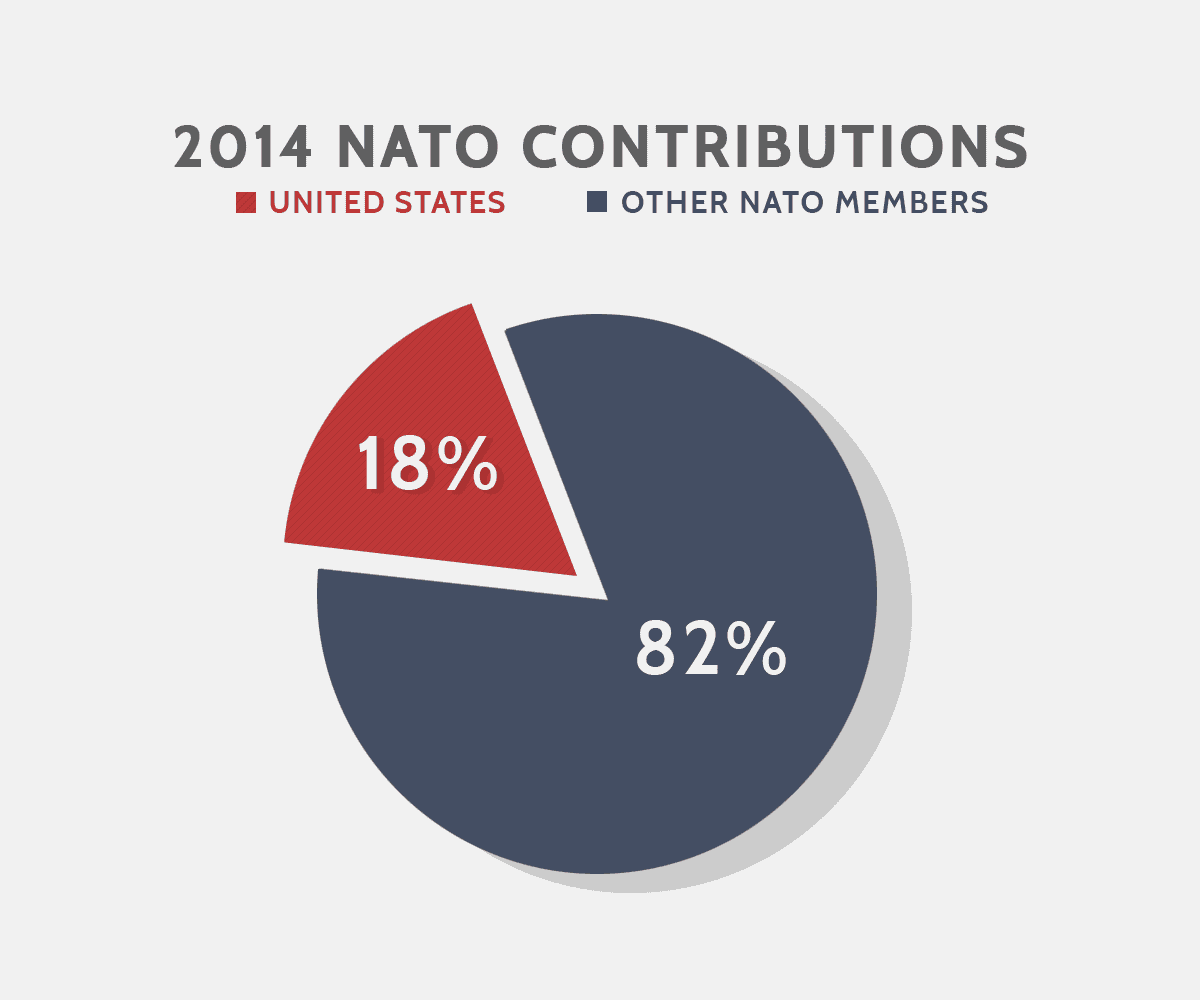
(American Action Forum)

One actor takes on the costs — and reaps the biggest share of the benefits

The puzzle of statehood

Governing a large state is very costly — huge collective action problem

Unlikely to solve the problem via selective incentives

  • Who has the resources to know who contributed, who didn’t?
  • Who has the power to effectively punish non-contributors?

But then who is going to step in and take on all the costs of establishing a state?

And once they do, what’s to stop them from stealing everything from the subjects under their control?

Olson’s answer: incentives are right for a stationary bandit

A predatory theory of statehood

States of anarchy

One Piece, ch. 1

Anarchy: no centralized authority to provide security or enforce contracts

World of “self help” — must provide own defense/enforcement

Examples

  • Prehistorical humanity
  • Caribbean pirate era, 1650–1730
  • China’s Warlord Era, 1916–1928
  • Somalia, 1991–2012 (or longer)
  • Eastern DRC, 1990s–present

Roving bandits

An old question — in a “state of nature” (anarchy), will we all be nice to each other, or all kill each other?

More realistic premise: some people will predate upon others

Characteristics of the roving bandit

  • Does not produce economically valuable goods
  • Lives by stealing production from others
  • “Invests” in means of theft: arms, horses, cronies
  • Opportunistic — finds a chance to steal the most value facing the least resistance, then moves on to a new target
  • Essentially a parasite on the economy

Roving banditry and economic incentives

A very simple model of the human economy

  • People choose how much time/effort to spend laboring
  • Labor produces output, which people divide between…
    • Consumption, including subsistence (bare minimum to stay alive)
    • Investment, raising future labor productivity
    • Defense, protecting consumption + investment from predation
  • Goal is to maximize lifetime consumption, minus labor costs

Discuss with your neighbors: What does the balance of labor look like in a world without bandits? As the frequency and threat of banditry increases, how does this balance change?

Roving banditry is even bad for the bandits

Little incentive for a roving bandit to limit their predation

  • If you don’t steal it today, someone else will tomorrow
  • Only limiting factor is retaliation from the targets

\(\leadsto\) little incentive to produce/invest above subsistence line

  • Going to lose it all to a bandit eventually
  • Surplus should go to defense, or just leisure

\(\leadsto\) leaving relatively little for the roving bandits to take!

From roving to stationary banditry

Olson’s claim: expect a stationary bandit to emerge from anarchy

Key features of a stationary bandit

  • Steals from the same set of people/territory repeatedly over time
  • Monopolist: stops other bandits from stealing from these subjects

Central argument: this is better for both the bandit and the subjects

  • Subjects get protection + better economic policy
  • Bandits get more surplus than if they were roving
  • This “system” becomes self-sustaining

Roving versus stationary incentives

Unlike a roving bandit, a stationary one doesn’t want to steal everything

No surplus today \(\leadsto\) no investment today \(\leadsto\) less surplus tomorrow

(nerd voice) The bandit-optimal tax rate is less than 100%

Stationary bandit won’t just limit theft — it’ll create conditions for investment

  • Absorb the defense burden, protect against outside threats
  • Provide some rule of law + internal policing
  • In other words, the essential functions of statehood

Longer “time horizon” for the bandit \(\leadsto\) more incentive to act like a state

The lion versus the housecat

  • Will kill you and eat you
  • Always on the hunt
  • Always starving

  • Meows at me, knocks things over
  • Knows exactly when + where food is
  • Only pretends to be starving
Who’s got the better life?

Evidence for Olson’s theory

Deriving hypotheses

If Olson’s theory of stationary bandits emerging under anarchy is correct, what patterns should we expect to observe?

  1. Stationary bandits will establish where the potential gains are highest
    • High value of whatever is produced locally
    • Low defensibility against bandit theft
  2. Longer time horizon among bandits \(\leadsto\) better treatment of subjects
  3. The economy does better under a forward-looking stationary bandit than under anarchy

Problem: Very hard to measure these variables for the times when most present-day states were being formed!

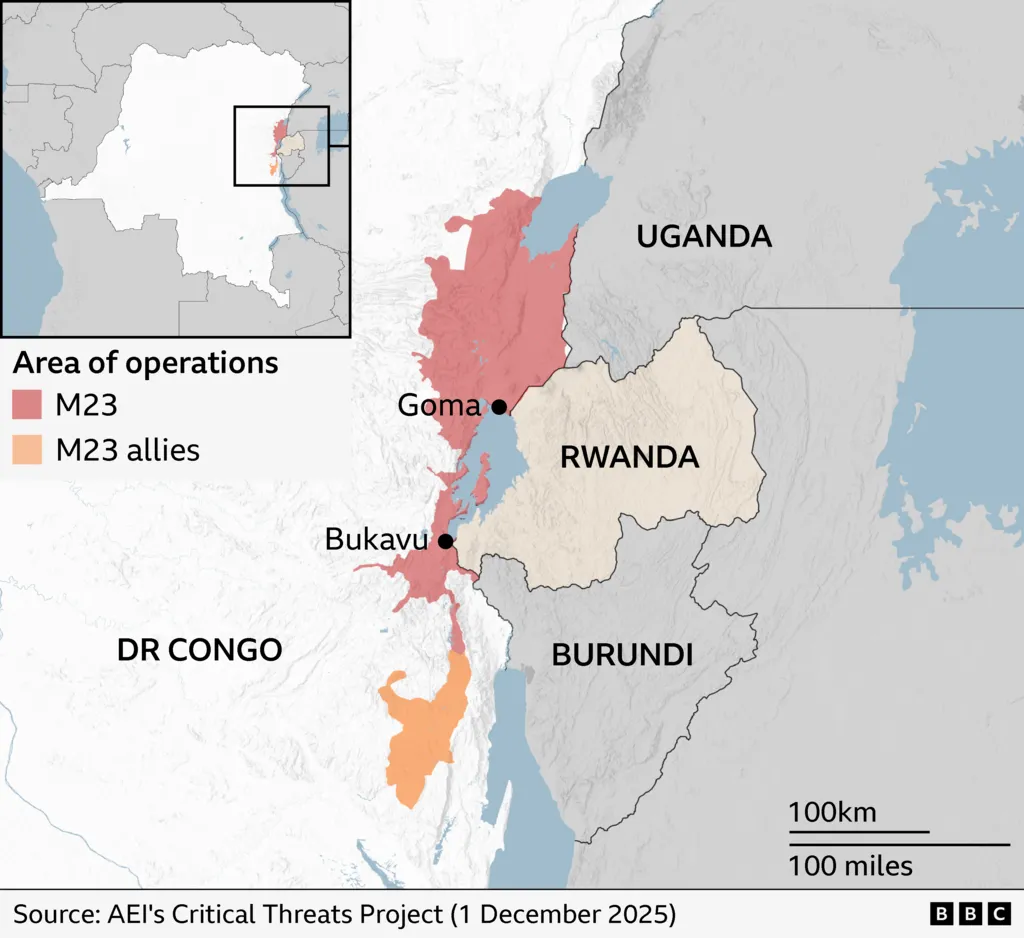
Context: Eastern DRC

To test theory, need data on somewhere with roving bandits — state of anarchy

Sánchez de la Sierra’s answer: Democratic Republic of Congo

No central control in east — numerous armed rebels

Production for global markets

  • Coltan: bulky, hard to transport
  • Gold: small, easily hidden

Eastern DRC in 2025 (BBC)

Hypothesis 1: Where do bandits settle down?

  1. Stationary bandits will establish where the potential gains are highest: high value, low defensibility
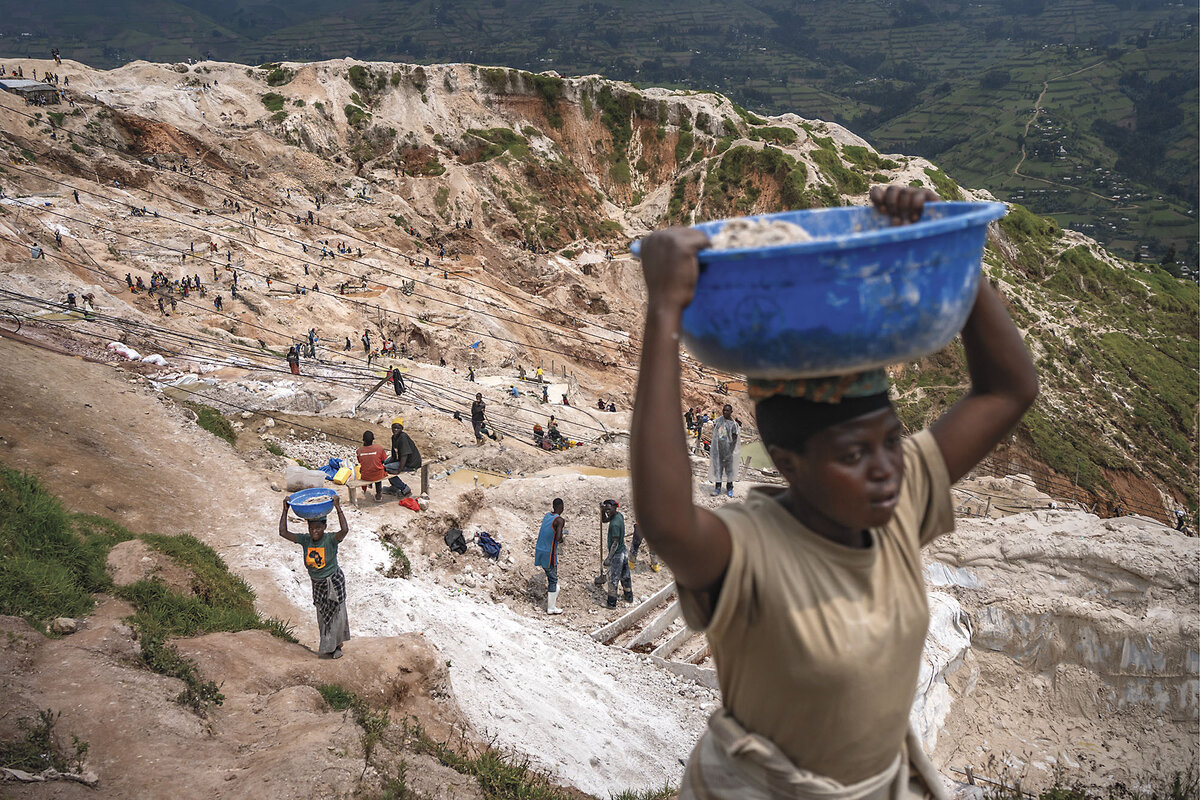
Coltan mining (Christian Science Monitor)

Bulky, costly to transport

Increase in price \(\leadsto\) rebels tax production sites where coltan is mined

Gold mining (PRI)

Easy to hide — hard to tax production

Increase in price \(\leadsto\) rebels tax support village where earnings are consumed

Hypothesis 2: How do bandits behave?

  1. Longer time horizon among bandits \(\leadsto\) better treatment of subjects

How to measure time horizon? Type of armed group


Village militia Regional militia Army External militia
Villages controlled 136 98 153 206
Attacks per village controlled 0.01 2.6 0.2 2.6
Provide security at mine 77% 62% 69% 62%
Provide security to village 59% 28% 72% 29%

Hypothesis 3: Are regular people better off?

  1. The economy does better under a forward-looking stationary bandit than under anarchy
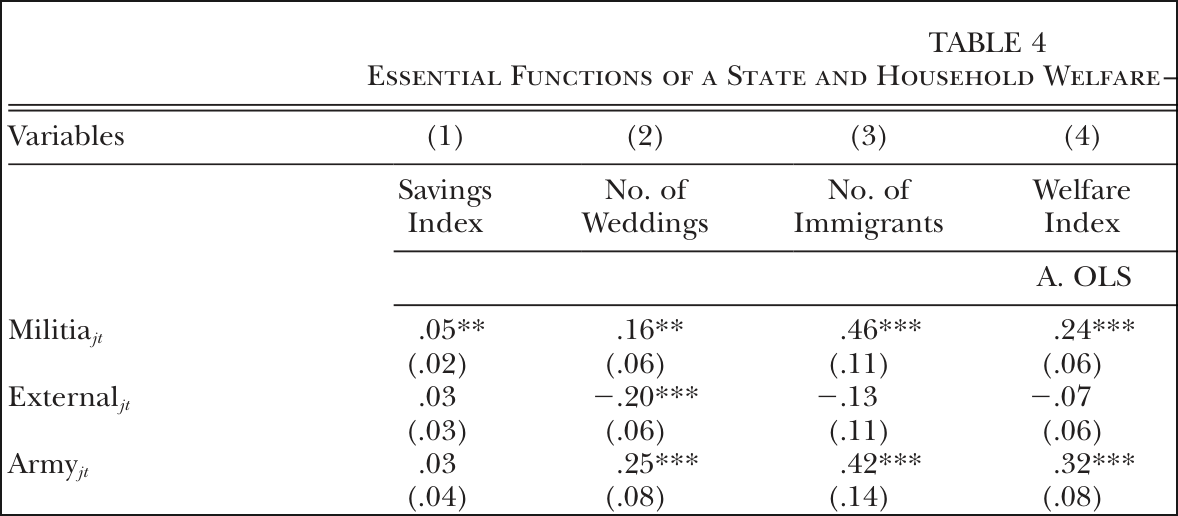
Sánchez de la Sierra 2020, Table 4

Wrapping up

The big picture

Olson’s theory

  • Collective action problem \(\leadsto\) state won’t emerge from voluntary action
  • Instead, expect a criminal group to monopolize violence
  • Long enough time horizon \(\leadsto\) governance becomes less criminal

Sánchez de la Sierra’s evidence

  • Eastern DRC as closest approximation of anarchic environment
  • Militias monopolize violence where there’s high value they can easily extract
  • Population treatment + welfare are best under state army / militias with local ties

To do for next time

No class Monday for MLK holiday!

  • Optional bonus thought exercise: Read MLK’s Letter from Birmingham Jail in light of Olson’s skepticism of collective action and theory of how states democratize
  • Interesting history of the civil rights movement through the lens of military history: Thomas Ricks’ book Waging a Good War

Next Wednesday: core account of war’s influence on European state development

  • Read posted chapter from Tilly’s book Coercion, Capital, and European States
  • Reading guide to be posted by this Friday