Introduction to the course
PSCI 2227: War and State Development
January 5, 2026
Agenda for today
Introductions
Learn a bit about the course topics
Talk through assignments, grading, and other syllabus stuff
Answer any and all lingering questions
Introductions
This course
PSCI 2227: War and State Development
Mondays and Wednesdays, 2:20–3:45pm, Alumni Hall 201
First time this is being taught at Vanderbilt!
Counts for international relations or comparative politics in PSCI major
About me
- “Kenkel” rhymes with “sprinkle” 🧁
- Grew up in Northern Kentucky, near Cincinnati
- Philosophy and political science major at University of Kentucky (2008)
- PhD in political science from University of Rochester (2014)
- On the Vanderbilt faculty since 2014
- Research + classes on international relations, game theory, statistics
Email: brenton.kenkel@gmail.com (preferred over Vanderbilt email)
Office hours: Tuesday 2-3:30pm, Commons 326, no appointment needed
War and state development
Three important patterns in Europe
In the second half of the last millenium…
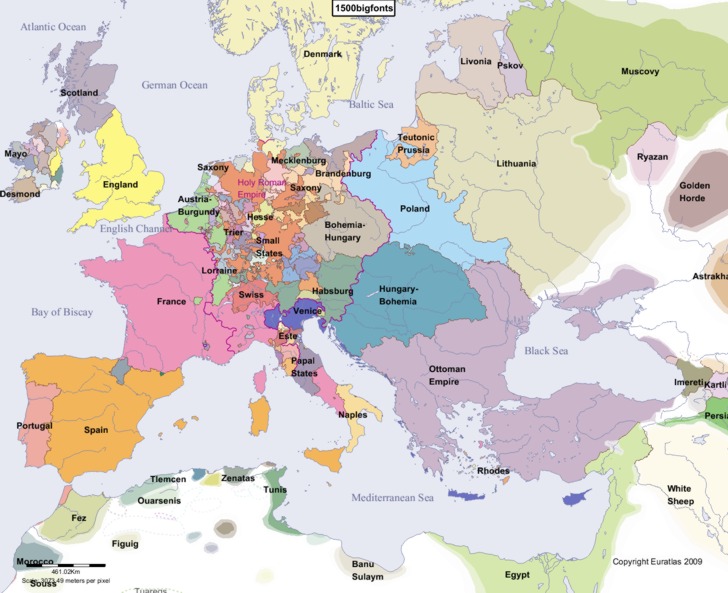
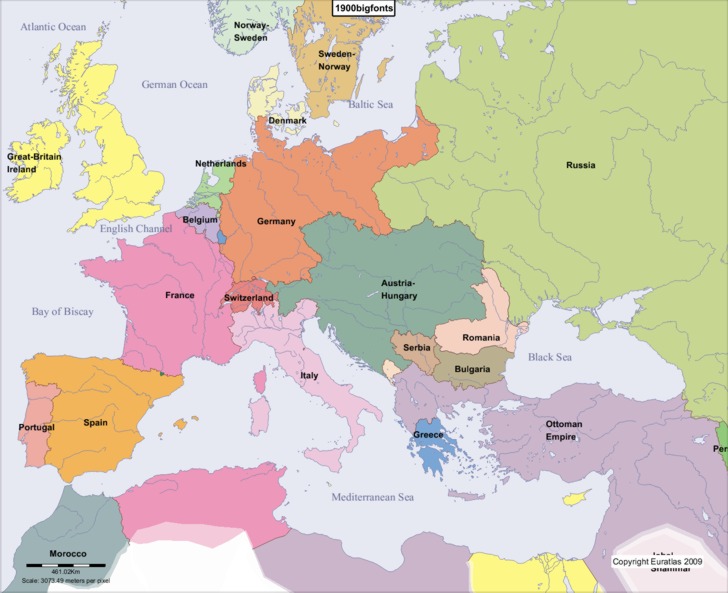
- Europe went from hundreds of (mostly) small states to about 30 big ones
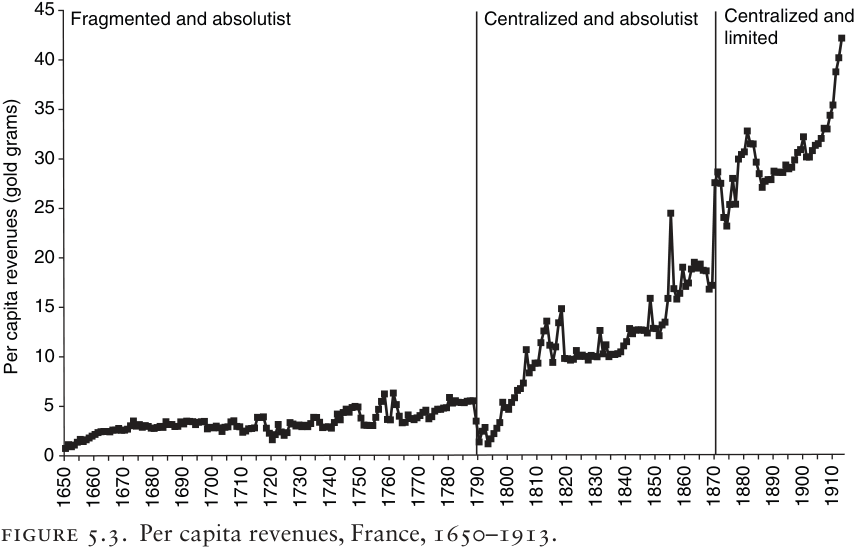
- The capacity of these states rose dramatically
- They raise a lot more revenue
- They provide many more services
- Their governments are much more representative of all citizens
- In the meantime, these states fought many wars against each other
1. Consolidation
Europe in 1500:
1. Consolidation
Europe in 1900:
2. Capacity
3. War
Major wars in Europe, 1500–1900:
| War | Dates | Deaths | % of Pop. |
|---|---|---|---|
| Italian Wars | 1494–1559 | 300,000–400,000 | ~0.5% |
| French Wars of Religion | 1562–1598 | 2–4 million | 2.5–5% |
| Eighty Years’ War | 1568–1648 | 600,000–700,000 | ~0.7% |
| Thirty Years’ War | 1618–1648 | 4.5–8 million | 5–8% |
| War of the Spanish Succession | 1701–1714 | 400,000–1.2 million | 0.4–1.1% |
| War of the Austrian Succession | 1740–1748 | 400,000–500,000 | ~0.4% |
| Seven Years’ War | 1756–1763 | 900,000–1.4 million | 0.6–1% |
| French Revolutionary Wars | 1792–1802 | 600,000–1.5 million | 0.3–0.8% |
| Napoleonic Wars | 1803–1815 | 3.5–6.5 million | 2–3.5% |
| Crimean War | 1853–1856 | 600,000–750,000 | ~0.2% |
| Franco-Prussian War | 1870–1871 | 180,000–200,000 | ~0.06% |
Questions we’ll be asking
To what extent did all these wars cause territorial consolidation?
And to what extent did they cause subsequent increases in…
- tax revenue?
- public representation?
- national identity?
- bureaucracy?
How special was Europe? Do we also see these patterns in the Americas, Asia, and Africa?
Methods of inquiry
Theory. Can we construct logically coherent explanations for why warfare would affect state consolidation and development?
History. When we look closely at how individual states developed, how much do the facts line up with the theoretical logic? What events do the theories explain poorly?
Statistics. Do the broad patterns in data on state development match up with what our theories would predict? Which patterns do the theories explain poorly?
The syllabus
Overview of grading
- 20% daily reading quizzes
- Lowest four scores (incl. absences) are dropped
- 15% midterm exam (in class on Monday, February 23)
- 20% final exam (9:00am on Thursday, April 23)
- Date set by College, not changeable or negotiable
- 45% research project
- 5% proposal due February 13
- 15% first draft due March 20
- 25% final paper + revision memo due April 17
Two extra credit opportunities: RIPS Lab, course evals
Daily readings + quizzes
One article/book chapter per class
Reading guides posted on Brightspace and https://bkenkel.com/wasd
Five-minute reading quiz at start of each class
- Single short answer question
- Covers central topics of reading, no trivia or “gotchas”
- Grades: Full credit (100%), partial credit (75%), no credit (0%)
- Four lowest scores dropped from final average
No “attendance policy,” but reading quizzes must be taken in person
- You can walk out right after — not recommended, but won’t affect grade
Exams
Midterm on February 23, final on April 23
Split between short answers and 1–2 longer essays (1 on midterm, 2 on final)
Open notes, but no electronic devices
Final is cumulative, but will mostly cover post-midterm content
Research project: Overview
Central aims of the project
- Make an argument about how war affects an aspect of state development
- Use historical evidence to test that argument
Start thinking about potential topics from day one
Don’t be shy to email me or drop by office hours to talk about topics!
No formal restrictions on ChatGPT/AI usage
- Probably not a good idea to have it write the whole thing for you
- We’ll talk repeatedly in class about smarter/dumber uses of AI for research
Research project: Specifics
- Proposal due February 13 (5% of final grade)
- 2–3 pages
- Preview your argument, discuss historical cases you plan to study
- List sources you plan to consult
- First draft due March 20 (15%)
- Complete draft of paper, 15ish pages
- I will give you detailed feedback for final draft
- Final draft and revision memo due April 17
- Revision memo will detail changes since first draft
- Paper itself is 20% of final grade, memo is 5%
A final project and a final paper… wtf
Why would I make you do this? Is it sheer pedagogical cruelty?
- Exams test the breadth of your knowledge of the course topics
- Final project will have you go in depth on a single topic you care about
- Both are important!
The requirements aren’t as backloaded as you might fear
- The real “hard part” for the project is the first draft due March 20
- Feedback from there will give a clear path for the final paper
Any more syllabus questions?
Next time
Topic: The not-so-inevitable development of sovereign states
- What do we mean by the “state” in “state development”?
- What other forms of political organization could have prevailed instead?
Reading: Spruyt 1994, “Institutional Selection in International Relations”
- Reading quiz will be given for practice only (not graded)
- First graded reading quiz will be next Monday, January 12
One more thing:
- Please fill out pre-course survey via link on Brightspace